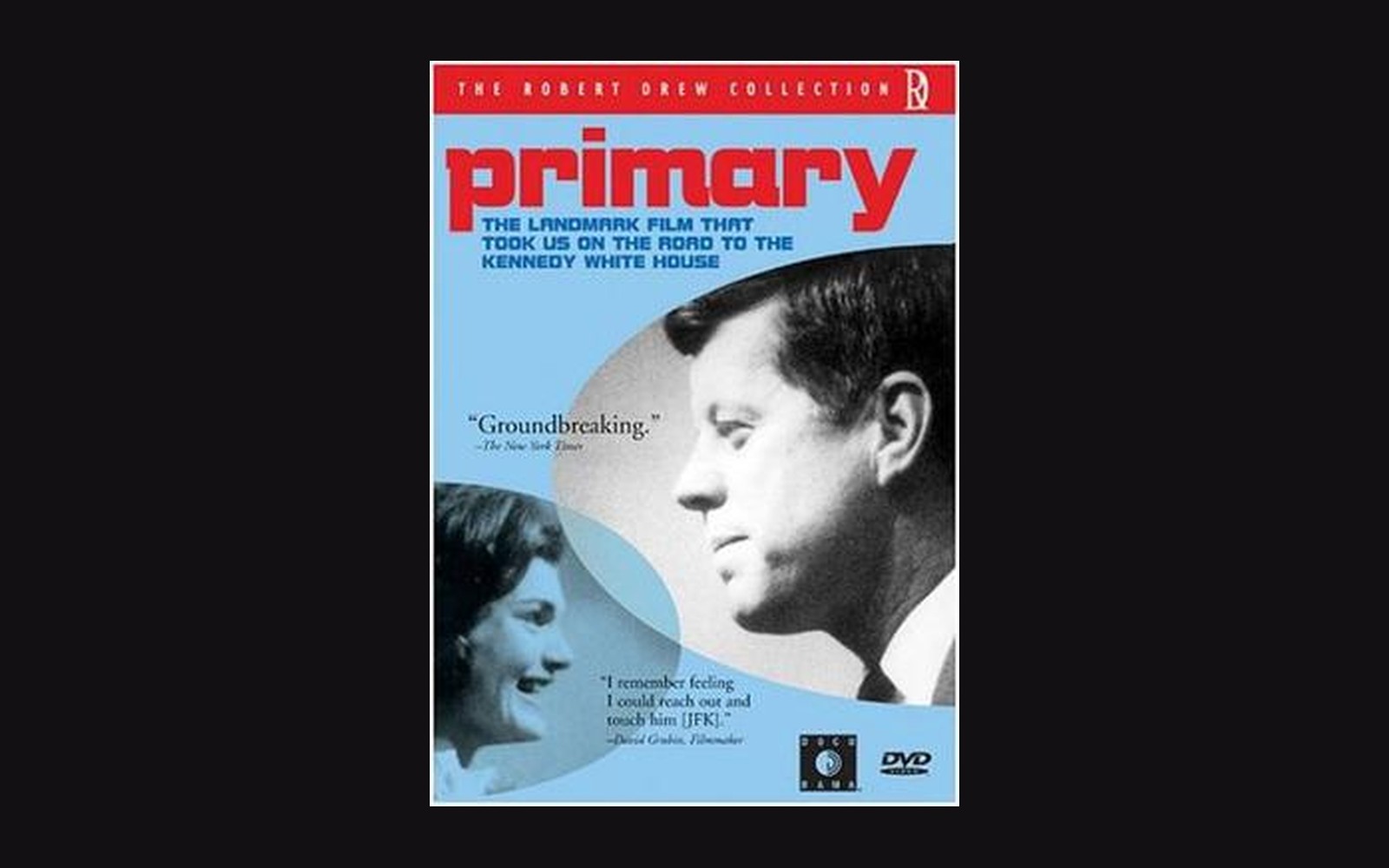
Forty-five seconds through a crowd and a door without a cut — the founding document of American Direct Cinema.
Following Kennedy Through a Door
Forty-Five Seconds That Changed American Documentary
Primary (1960), directed by Robert Drew with Richard Leacock, D. A. Pennebaker, and Albert Maysles, is the founding document of American Direct Cinema — and its claim rests on a single sequence. The camera follows John F. Kennedy through a crush of supporters, into a building, down a corridor, and through a door onto a stage, all without a cut. For roughly forty-five seconds, the viewer is simply there. No narration, no interview, no cutaway to commentary. This had not been done before in American documentary.
The occasion was the April 1960 Wisconsin Democratic primary, a contest between Kennedy and Hubert Humphrey that both campaigns understood as a proving ground. Drew Associates — the production unit Robert Drew had built under the umbrella of Time Inc. — deployed cameras on both candidates. The gamble was technological as much as political. Leacock and Pennebaker were using early lightweight 16mm cameras synced to portable sound recorders, equipment still far from standardised. The rig that enabled the corridor sequence was handheld, mobile, and quiet enough not to clear a room simply by being switched on.
What Drew's unit had that their predecessors lacked was sync-sound portability — the ability to record picture and usable audio simultaneously while moving through space. Earlier documentary cameras either demanded a tripod or generated enough noise to make location sound unusable. The crowd noise behind Kennedy in that corridor, the thumping of the door, the sudden roar of the audience as he steps into the light: these are not added in post-production. They are the sound of the moment the camera entered.
The sequence is also a piece of political portraiture. Kennedy moves through the crowd with the focused, slightly glazed momentum of someone who has done this ten thousand times and still needs to look as though he hasn't. The camera's inability to intervene — to ask, to stop, to arrange — is what produces the image. Its witness is contingent, provisional, entirely dependent on being allowed to keep up.
Chronology
- April 1960Wisconsin Democratic primary filmed
- October 1960Primary broadcast on ABC television
- Drew Associates unitDrew, Leacock, Pennebaker, Albert Maysles
Primary premiered on ABC television in October 1960. It was not a theatrical release but a television broadcast, which is where its audience found it and where its influence first spread — through editors, journalists, and younger filmmakers who suddenly understood what a camera could be asked to do. Frederick Wiseman, Barbara Kopple, and the whole tradition of American observational documentary follow, in some measure, from that corridor.
Drew himself described his ambition as journalism by camera. The forty-five-second walk is, among other things, the proof that the description was not modest.
Read next in Direct Cinema