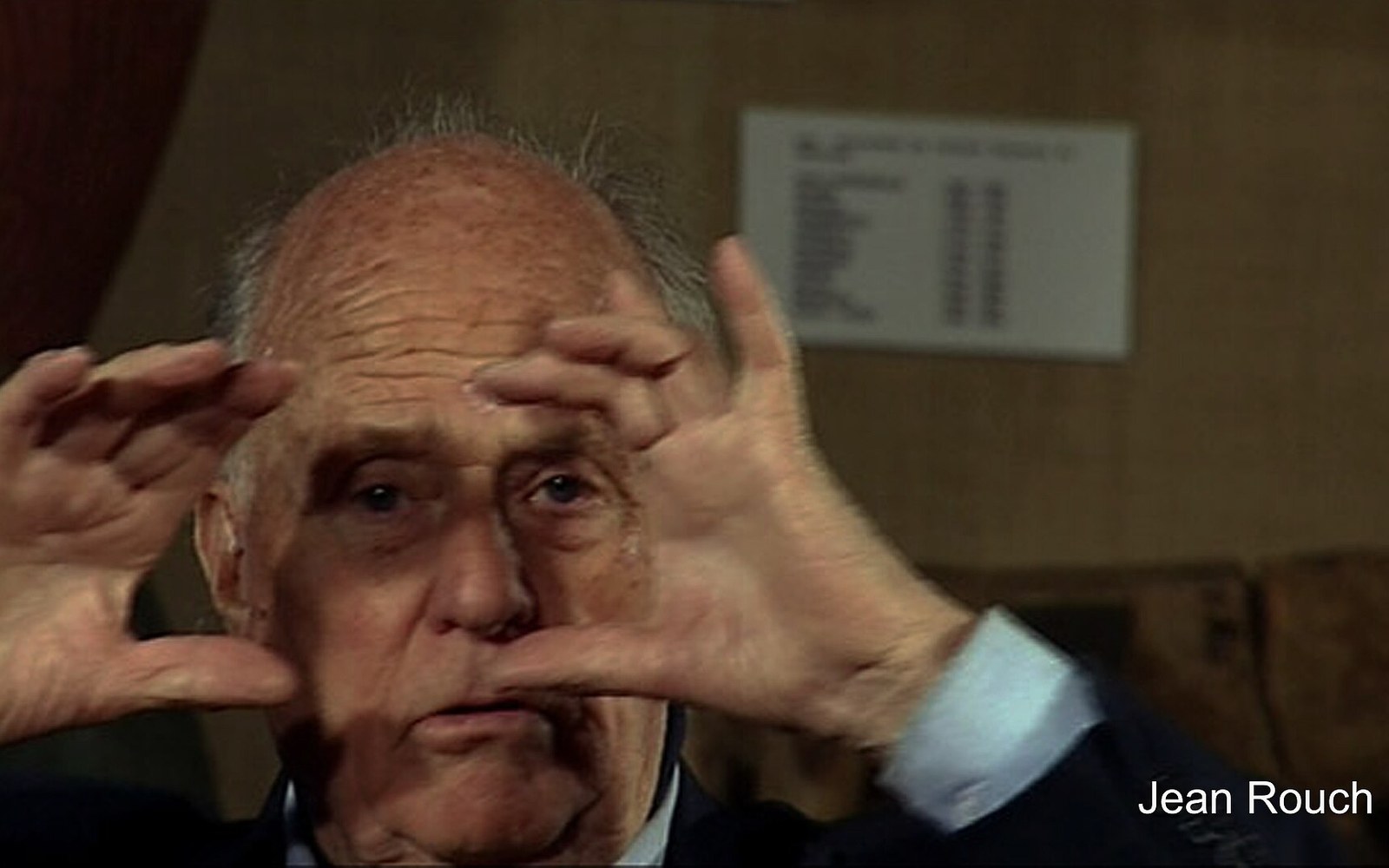
Rouch framing with his hands. In his own films he is audible, visible, and asking the questions.
Rouch Said the Camera Was a Provocation
The Witness and the Catalyst
Two movements shared the same lightweight cameras and reached opposite conclusions about what honesty required.
When Primary (1960) sent Robert Drew's team into the Wisconsin primary with lightweight, synchronised 16mm camera and sound equipment, the premise was invisibility: the camera would not intervene, would not speak, would record events as they broke. That is the Direct Cinema faith — that the camera, held steady and silent enough, becomes a transparent window onto the real.

Jean Rouch rejected that premise entirely. In Chronicle of a Summer (Chronique d'un été, 1961), made with sociologist Edgar Morin on the streets of Paris, Rouch is present, audible and consequential. He walks into frame. He and Morin ask strangers whether they are happy, pressing subjects who grow visibly uncomfortable, who argue back, who revise their answers mid-sentence. The camera is not a window; it is, as Rouch described it, a provocation — a tool for generating truth that would never surface unprompted.
This is cinéma vérité — a term Rouch borrowed from Dziga Vertov's Kino-Pravda newsreels — and its logic inverts Direct Cinema's. Where Drew and Leacock believed that the camera's presence falsified events and therefore had to be minimised, Rouch believed that pretending the camera was absent was itself a falsification. Acknowledging it, using it as a catalyst, was the more honest method. Chronicle of a Summer ends with Rouch and Morin screening the footage to the people who appear in it, watching them react to their own onscreen selves: the filmed are now the audience, the apparatus completely exposed.
The split still structures how documentary is taught and debated. Direct Cinema produces films that feel like surveillance; cinéma vérité produces films that feel like encounter. Whether you trust the unobserved moment or the provoked one determines which tradition you work in — and both traditions, it is worth noting, began with the same pocket-sized Swiss tape recorder and the same near-silent 16mm camera, within the same two years.
Read next in Direct Cinema