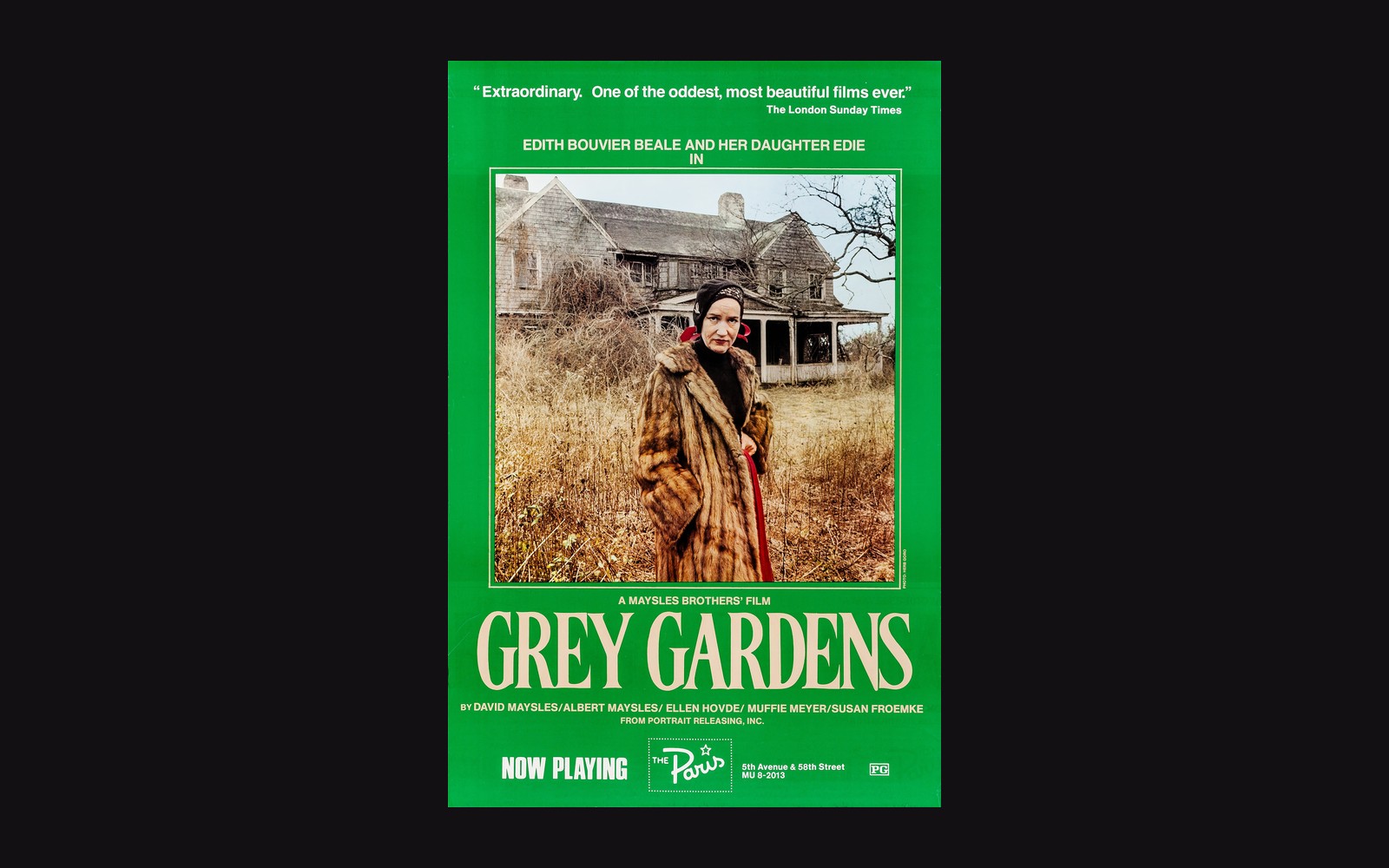
The Beales knew exactly where the camera was, and the release artwork sells that knowledge as the attraction.
What the Maysles Found on Georgica Pond
A House, Two Women and the Limits of Observation
Grey Gardens (1975) is the film that tested Direct Cinema's central promise — and found it more complicated than its makers had claimed.
Albert and David Maysles arrived at the crumbling East Hampton property in 1973, accompanying a journalist covering the eccentric living conditions of Edith Bouvier Beale and her daughter, also Edith — known to everyone as Little Edie. The older woman was an aunt of Jacqueline Kennedy Onassis (and Little Edie her first cousin); the house at Georgica Pond had once been a prosperous summer estate. By the time the Maysles brothers turned their cameras on it, Grey Gardens had become something between a sanctuary and a ruin, its rooms invaded by cats and raccoons, its grounds overtaken, its two inhabitants sealed inside a world of their own making.
The film that emerged from roughly two years of visits ran 94 minutes and was co-directed with Ellen Hovde and Muffie Meyer, who shaped the material in the editing room. What it contained confounded the observational mode the Maysles had helped define. The Beales were not simply being watched. They were performing — for the camera, for Albert and David personally, and for whatever idea of themselves they wished to transmit to the world. Little Edie addresses the brothers by name, stages entrances in pinned-up skirts and headscarves she describes directly to camera, and at one point declares that a particular moment is "the best film I've ever been in." Big Edie sings, argues, remembers, and reclines with the confidence of someone who has decided that company is welcome.
Participation and What It Costs
This is what separates Grey Gardens from the Direct Cinema orthodoxy established by Robert Drew and his colleagues at Drew Associates: the subjects are not going about their lives indifferent to the camera's presence. The encounter is the film. Jean Rouch's term cinéma vérité — the idea that the camera acts as a catalyst, provoking revelation rather than merely capturing it — fits the Grey Gardens material far more accurately than the American observational model the Maysles nominally belonged to. The Beales use the camera as an audience, and that use produces something no fly-on-the-wall crew could have obtained.
This raises the ethical questions the film has never entirely escaped. The Maysles maintained a close, affectionate relationship with both women; Albert in particular returned repeatedly and developed something close to friendship with Little Edie. Defenders argue that the film is an act of genuine connection, that the Beales were neither exploited nor misrepresented, and that their pleasure in performing is itself the subject. Critics have pointed out that the gap in social resources between the filmmakers and the filmed — two women in material distress, however aristocratic their origins — is impossible to set aside entirely. The film holds both of these readings without resolving either.
What it does unambiguously document is a particular kind of interior life: the mythology two people construct when the external world contracts to one address. Big Edie and Little Edie have worked out, between them, an elaborate system of shared memory, grievance, nostalgia and mutual dependency that the camera does not create but does, unmistakably, animate. The house on Georgica Pond — peeling wallpaper, a bed covered with portraits and magazines, cats eating on a kitchen counter — becomes a physical extension of that inner world. Albert Maysles's handheld 16mm camera, the same lightweight equipment that enabled the Direct Cinema movement, moves through these rooms with an intimacy that never feels like intrusion, partly because the inhabitants have decided it isn't one.
The film's position at the edge of Direct Cinema's own claimed rules is, in the end, its value to the documentary tradition. It demonstrates that observational cinema's categories — who watches, who performs, who is in control of the encounter — are more permeable than any manifesto acknowledges. By the time the Maysles left Georgica Pond, they had made a film that their own movement could not quite contain, and that has grown only more difficult to categorise in the decades since.
Read next in Direct Cinema