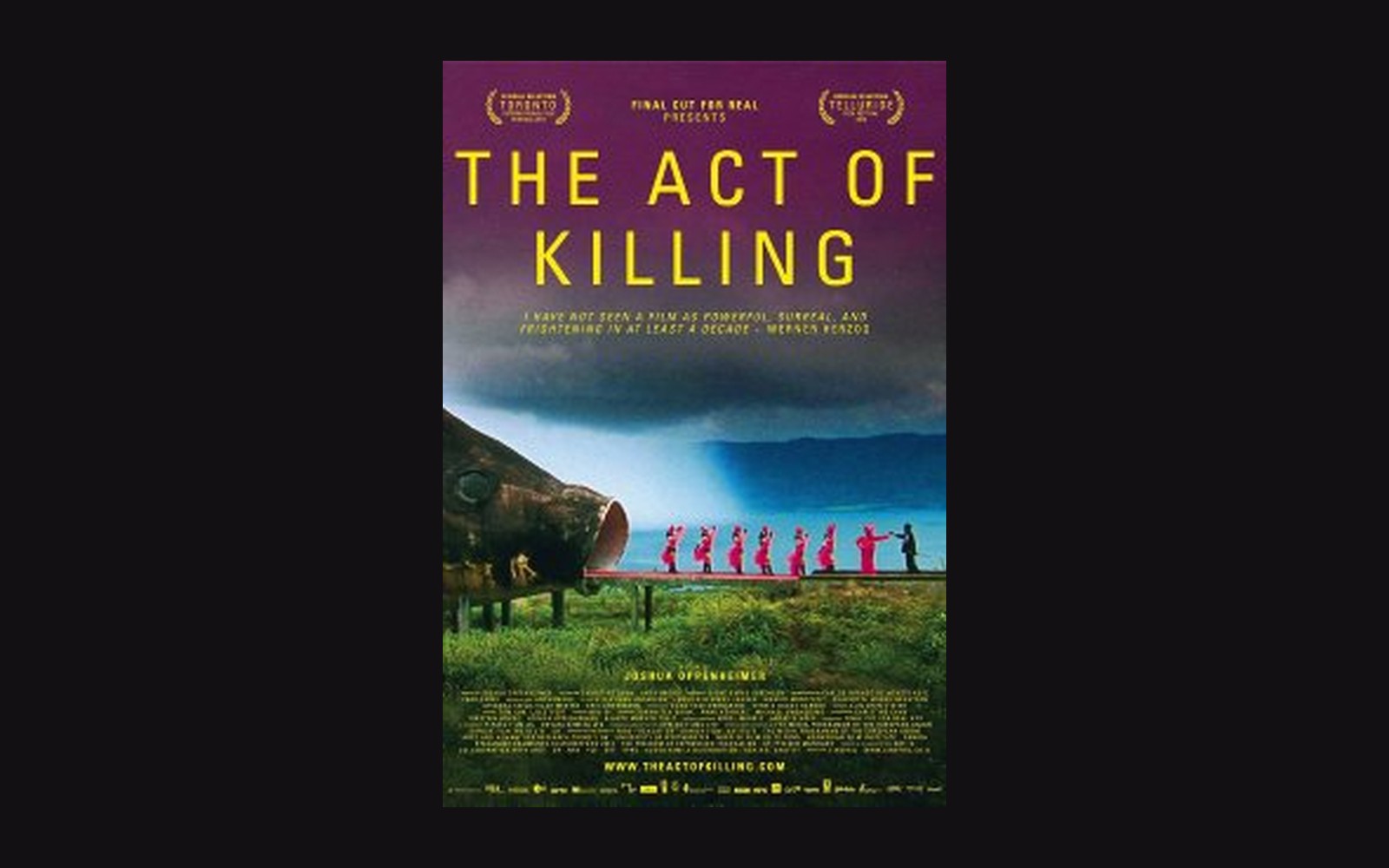
The perpetrators chose the genre they wanted to be filmed in, so the poster is their own staging.
Perpetrators in Costume
When Killers Choose Their Genre
Joshua Oppenheimer's The Act of Killing (2012) asked death-squad leaders to stage their own atrocities on film — and in doing so, made one of the most unsettling ethical experiments in documentary history.
The Invitation and What It Produced
The premise is deceptively simple: ask the men who ran Indonesia's anti-communist death squads in 1965–66 — men who killed hundreds of thousands and who, crucially, have never faced prosecution — to reenact their killings in whatever cinematic style they choose. Gangster films, musicals, westerns: Anwar Congo and his associates, still powerful figures in contemporary Indonesian society, agreed with apparent enthusiasm. What Oppenheimer captured was not confession but performance, and the distance between those two things is where the film's meaning lives.
The death-squad leaders dressed up, choreographed torture scenes and took evident pleasure in directing them. The film's early sequences carry a specific, sickening quality: these men inhabit the vocabulary of Hollywood genre with no apparent shame, because in their world there is nothing to be ashamed of. The Indonesian state never held a reckoning. The killers were celebrated as patriots. Oppenheimer's method exposed that impunity by letting it speak in its own voice.

What the reenactments produced, over time, was something neither fully scripted nor fully documentary — a staged spectacle that began to crack under its own weight. By the film's close, Anwar Congo, revisiting the rooftop where he strangled prisoners, is shown undergoing what appears to be a physical convulsion of revulsion. Whether this represents genuine moral reckoning, the pressure of performance, or something the camera simply catalysed is left entirely open. The Thin Blue Line had already established that reenactment could be a tool of truth; The Act of Killing asked what happened when perpetrators themselves held the directorial pen.
Ethics, Collaboration and the Herzog Question
From the moment it premiered at the Telluride Film Festival in September 2012, the film generated a debate that ran alongside its awards campaign. Werner Herzog and Errol Morris served as executive producers, lending the project significant authority within documentary culture. Herzog's involvement was meaningful beyond prestige: his own career-long fascination with obsession, self-delusion and the darkness of human spectacle — visible in Grizzly Man and elsewhere — gave him an obvious sympathy with Oppenheimer's approach.
The ethical objections were substantive. Critics argued that allowing killers to perform their crimes — in costumes, with production design, in flattering generic frames — risked glamorising them, giving propaganda tools to men who needed none. Oppenheimer's counter-position, implicit in the film's structure, is that the spectacle of impunity is itself the argument: when perpetrators feel safe enough to perform this freely, the audience confronts a political obscenity that no conventional interview or archival approach could match. The film names many of its Indonesian collaborators in the credits only as "Anonymous" to protect them from reprisal — a detail that quietly registers what the perpetrators' cheerful openness does not: that real danger still circulates around this history.
The Act of Killing won the BAFTA for Best Documentary at the 2014 ceremony and was nominated for the Academy Award in the same category. A director's cut runs approximately 159 minutes; the theatrical cut runs around 116. The film prompted a sequel, The Look of Silence (2014), in which Oppenheimer reversed the approach: instead of filming perpetrators, he filmed Adi Rukun, a younger brother of one of the victims, confronting the killers face to face — men who still lived as his neighbours.
What the two films together demonstrate is that the participatory mode, the documentary method in which the filmmaker's encounter with subjects becomes the film's substance, can be pushed to an extreme that collapses the boundary between witness and actor. The Act of Killing is not a film about what happened in Indonesia in 1965. It is a film about what it looks like when a society decides that what happened does not need to be hidden — because the people who did it are still in charge.
Read next in Now