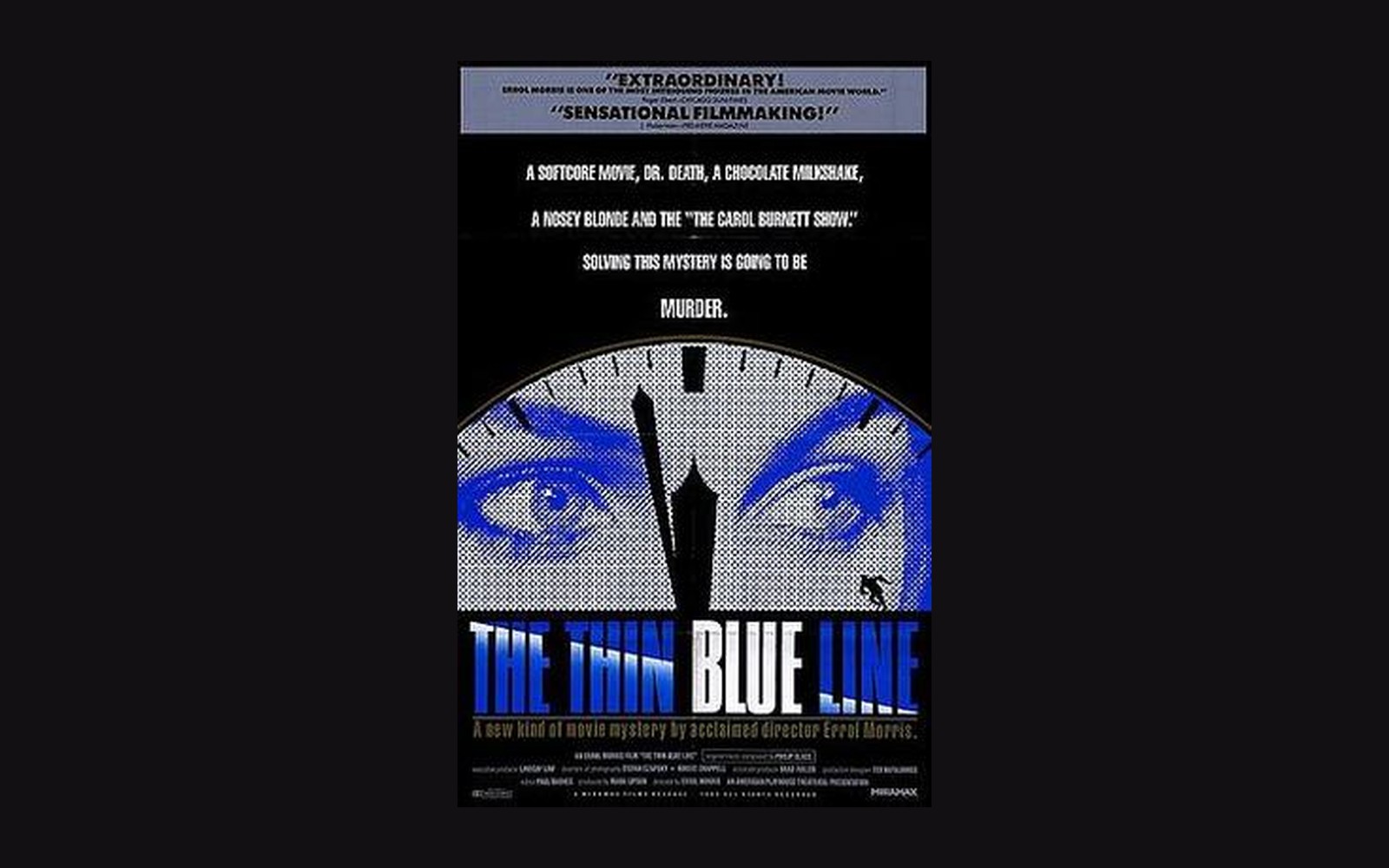
Morris advertised a murder mystery. The reenactments inside it changed what documentary was allowed to stage.
Errol Morris and the Reenactment Problem
A Murder, Staged and Restaged
The Thin Blue Line remade documentary from the inside out — and the form has been arguing about it ever since.
On 28 November 1976, a Dallas police officer named Robert Wood was shot dead during a routine traffic stop. Randall Dale Adams, a drifter from Ohio, was convicted of the murder and sentenced to death, later commuted to life imprisonment. By the time Errol Morris began filming in 1985, Adams had been inside for nearly a decade. The film that emerged, released in 1988, would eventually secure his release. It would also introduce a fault line into documentary ethics that has not closed since.
Morris had begun the project interested in a different man entirely — the psychiatrist James Grigson, known as "Dr. Death" — before turning to David Harris, the teenager who was in the car that night and who, the evidence increasingly suggested, had actually pulled the trigger. What Morris built from interviews, documents, and his own obsessive reconstruction of the crime scene was not a neutral record of testimony but an argument: a prosecutorial essay whose weapon was the staged image. He restaged the shooting itself, multiple times, from multiple perspectives, each version slightly altered to reflect a different witness account. Slow-motion close-ups of a milkshake falling to the pavement, a clock face, a revolver — objects rendered with an almost fetishistic deliberateness. Philip Glass's score, cycling and cycling like evidence refusing to resolve, amplified the sensation of a verdict perpetually deferred.
The Charge Against Morris
The objection was immediate and not frivolous. Documentary's implicit contract with the audience, runs the argument, rests on the indexical bond between image and reality: the camera captures what was in front of it. Morris broke that bond visibly and repeatedly. His reenactments were lit like noir, scored like opera, and explicitly fictional — they depicted events no camera witnessed. Traditionalists saw this as a fundamental betrayal: if reconstruction was permitted, what distinguished documentary from drama?
The counter-argument is more interesting. The film concerns itself with exactly the problem of testimony — with the way that eyewitness accounts of the same event diverge, contradict, and reshape themselves over time. Every reenactment in The Thin Blue Line is attributed to a specific narrator, staging that narrator's version rather than a neutral truth. Far from claiming the authority of the documentary image, Morris used reenactment to stage its impossibility. The multiplied, irreconcilable reconstructions do not illustrate what happened; they demonstrate that nobody in the film can agree on what happened, and that this disagreement put a man in prison.
The formal innovation had real-world consequences. Adams was granted a new trial in 1989, following a Texas Court of Criminal Appeals ruling that found the original prosecution had withheld evidence and suborned perjury. He was released that March. No earlier documentary made from wholly observational footage had done anything comparable — had, in the most literal sense, altered a court proceeding. The film's power came precisely from its constructed imagery, its scored accumulation of objects and angles, its refusal to pretend that truth was a matter of pointing a camera and waiting.
Morris built what functions as a legal essay film: argument through montage, not reportage through presence. The Philip Glass score — composed specifically for the film — is not illustrative background music but structural tissue, a rhythmic analogue to the film's pattern of claim and rebuttal. Together, image and music produce something closer to a brief than a chronicle, with Morris acting as advocate rather than witness.
The reenactment has since become one of documentary's most contested and widely adopted tools, from Nick Broomfield's staged reconstructions to the elaborate theatrical tableaux of The Act of Killing. Every filmmaker who has staged a past event for the camera since 1988 is working in Morris's shadow, whether they acknowledge the debt or not.
Read next in Essay Film