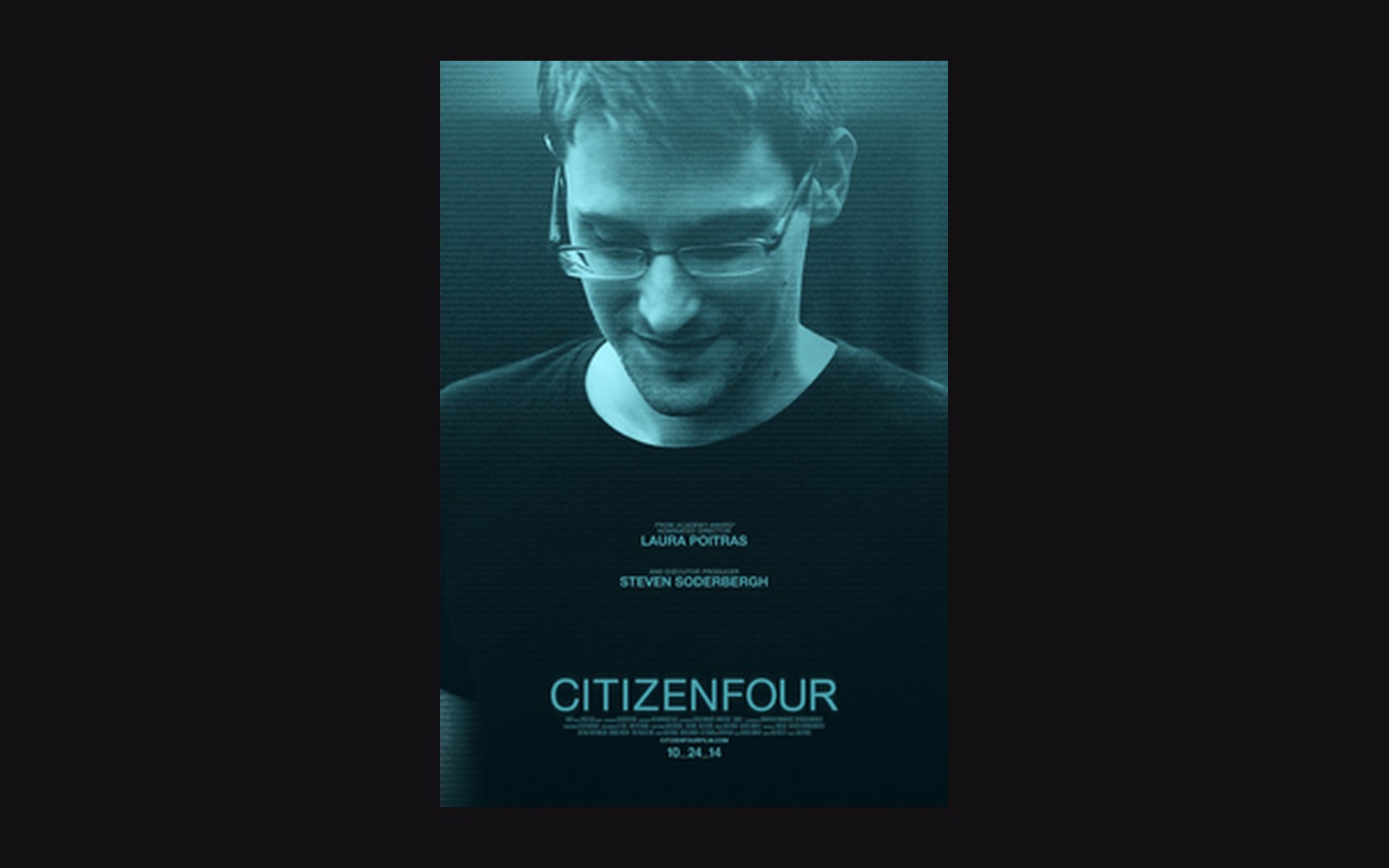
Eight days in a Hong Kong hotel room, filmed by a director who was under surveillance herself.
Eight Days in Room 1014
When the Subject Is Also the Method
Laura Poitras arrived in Hong Kong in June 2013 carrying a camera and a set of encrypted communications she had exchanged with a source who signed his messages "Citizenfour." What followed in room 1014 of the Mira Hotel was eight days of footage that became one of the few documentaries to win an Academy Award for a film that was, in its very making, an act of resistance to the apparatus it described.
The encrypted contact had begun months earlier. Poitras was already under government scrutiny — detained repeatedly at U.S. borders as a result of her earlier work on the Iraq War and on Yemen — which is to say the film's subject, mass surveillance, had already made her a subject of mass surveillance. That doubling is not incidental; it is the film's structural spine. The source turned out to be Edward Snowden, an NSA contractor, and the meetings in room 1014 produced both a global news story and a documentary in which journalism and filmmaking are inseparable.
Poitras made a formal decision early: the film would open with text on a black screen, her own words describing the encrypted communications, read aloud in her voice. It is an unusual choice, placing the filmmaker's interiority at the start rather than the action, and it frames everything that follows as already mediated — already coded, already at risk. When the camera finally enters the hotel room, the intimacy is genuine but the tension never dissolves. Glenn Greenwald and Ewen MacAskill are there; Snowden speaks with the composed precision of someone who has made an irreversible decision. The most unsettling images are the mundane ones: Snowden pulling a blanket over his head to type a password, a man combing his hair before he addresses the world.
Citizenfour won the Academy Award for Best Documentary Feature at the 87th ceremony in 2015 — a film edited partly in Berlin and distributed by Radius-TWC, produced while Poitras was living in self-imposed exile in Germany. The film belongs to the tradition of the participatory mode, in Bill Nichols's taxonomy, but it pushes that mode to an extreme: the filmmaker's presence is not just acknowledged but is itself evidence. The making is the meaning.
Read next in Now