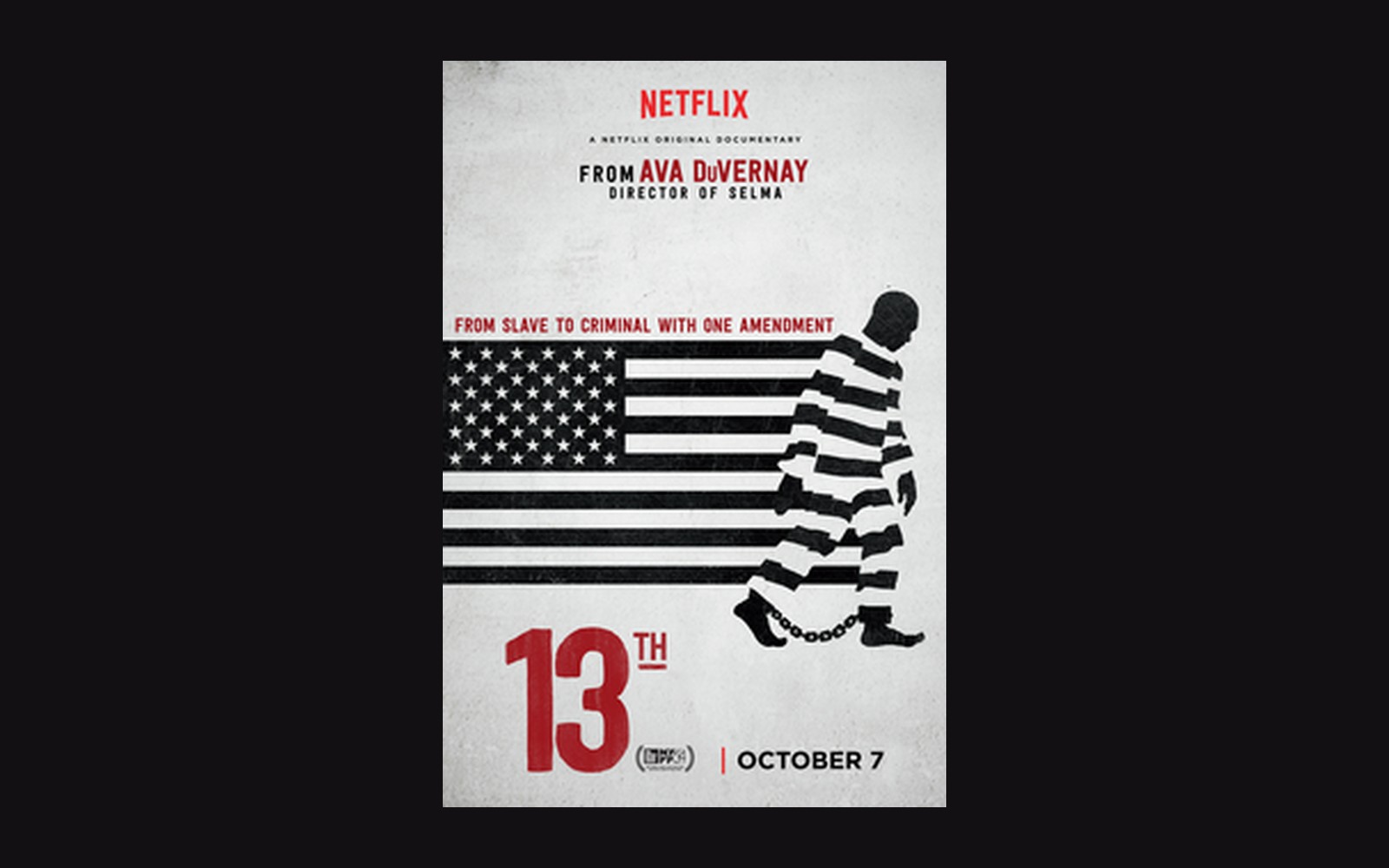
DuVernay's title is a clause of the Constitution, and the film is a reading of that clause.
The Thirteenth Amendment as Argument
One Clause, One Hundred Minutes
Ava DuVernay's 13th (2016) opens with a constitutional loophole and doesn't let go.
The Thirteenth Amendment abolished slavery in 1865 — except as punishment for crime. DuVernay's 13th treats that exception clause not as a historical footnote but as the load-bearing structure of modern American mass incarceration. Released on Netflix in October 2016 after its world premiere as the first documentary to open the New York Film Festival, the film arrives already primed as an argument, not a portrait: it wants to persuade, and it knows it.

The essay-film structure is the point. DuVernay assembles archive footage, talking-head interviews and animated typography into a single rhetorical unit, each element doing a specific job. The archive carries the historical claim — lynching photographs, chain-gang footage, news film of the civil rights movement, clips from The Birth of a Nation (1915) used to demonstrate how cinema itself circulated racist mythology. The interviews, drawn from scholars, activists and politicians across the political spectrum, carry the analysis. And the graphics — bold, percussive text that counts incarcerated Americans decade by decade as the numbers climb — carry the emotional force that statistics alone cannot. None of these modes operates independently; they are cut against one another so that each arrival of a number is already weighted by the archival image before it.
This is the essay film in its most disciplined form: not the lyrical digression of Chris Marker's Sans Soleil, but argument as architecture. The film's timeline is linear but its method is accumulative, each section adding another layer of legislation — Nixon's war on drugs, Reagan's mandatory minimums, Clinton's 1994 crime bill — until the structure of criminalization is visible as a constructed system rather than a series of accidents. Among those interviewed are Angela Davis, Bryan Stevenson, Newt Gingrich and Van Jones: the range is deliberate, designed to pre-empt the objection that the thesis is partisan.
At the time of its release, the United States held more people in incarceration than any other country, a fact the film places at the center of its legal and moral indictment. DuVernay does not pretend to observe; she editorializes, and does so openly, treating the camera not as an invisible witness but as an instrument of argument. In that sense 13th aligns itself with the participatory mode of documentary — not through the filmmaker's physical presence, but through the unambiguous shaping of every image toward a predetermined, explicitly stated conclusion.
That transparency is also its integrity. The film doesn't claim to be neutral. It claims to be right.
Read next in Now