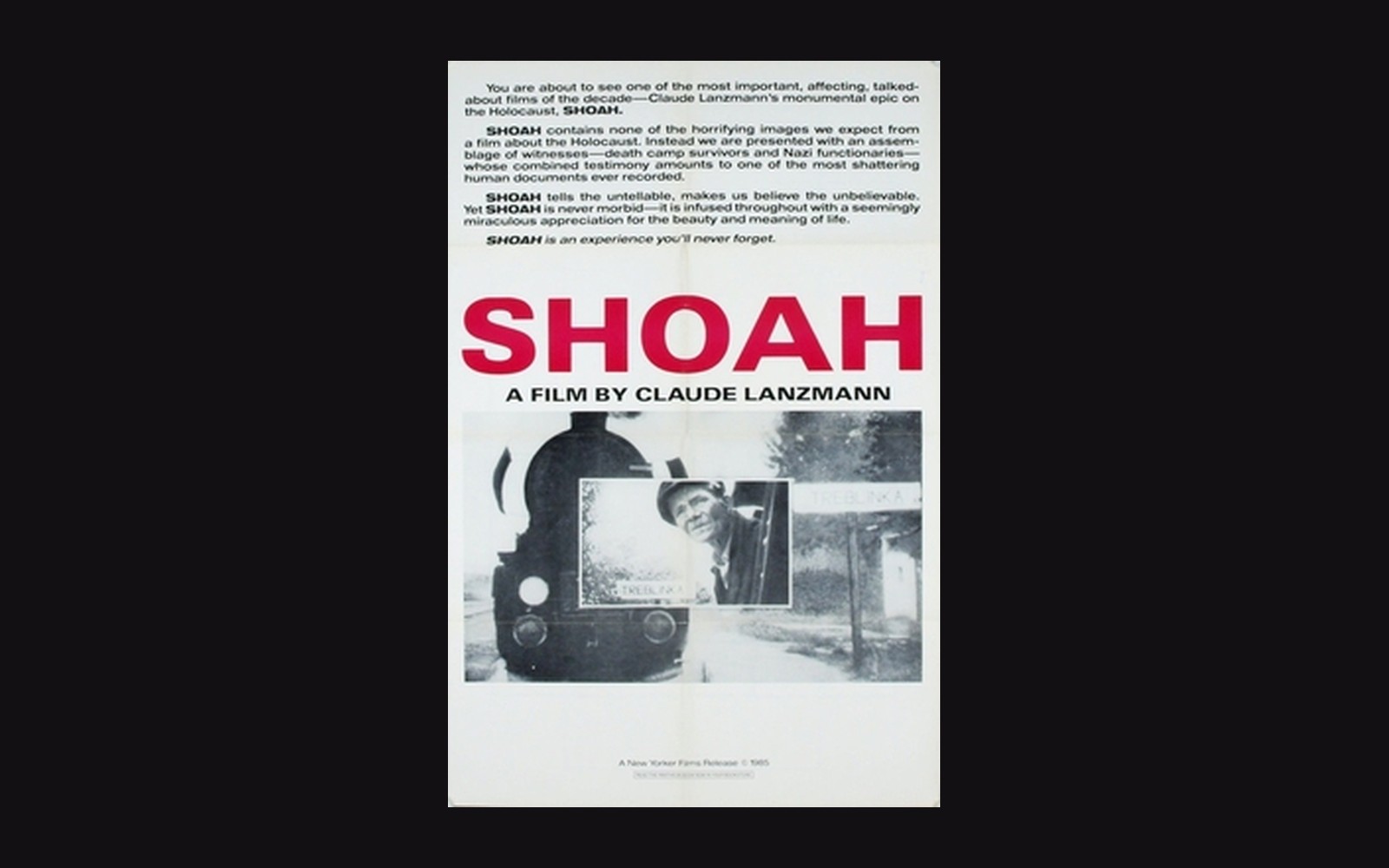
Nine and a half hours of testimony, and a distributor left to sell a film with no archive footage in it.
Nine Hours and No Archive Footage
The Formal Decision That Made the Film Possible
Shoah (1985) runs for nine hours and twenty-six minutes. It contains no archival footage, no photographs from the camps, no newsreel, no maps with animated arrows, no reconstructions. What it contains is testimony — survivors, perpetrators, bystanders — and the landscapes of present-day Poland, filmed as if the earth itself might still be made to speak. Every formal decision Claude Lanzmann made across the eleven years it took to produce the film flows from a single, absolute conviction: that the Holocaust cannot be represented through its documentary residue, and that to attempt such representation is to do violence to both the truth and the dead.
Lanzmann began filming in 1976 and continued through 1981, accumulating roughly 350 hours of footage across fourteen countries. He worked without a broadcaster's commission or institutional safety net, funding the project through a patchwork of French government support and the involvement of the French television network that would eventually broadcast it. The editing alone took years. The film premiered in Paris in April 1985 to immediate, contested recognition — not the Palme d'Or, which went elsewhere that year, but something rarer: a critical consensus that the cinema had produced something genuinely new, a work that seemed to belong to no existing category.
Testimony Without Illustration
The decision to exclude archival imagery was not pragmatic. Archive footage of the Nazi period exists in abundance, and Lanzmann was aware of how other filmmakers had used it. His argument, articulated repeatedly in interviews and essays over the decades that followed, was philosophical rather than logistical. He held that photographs and film taken inside the camps — or at their perimeters, by perpetrators — could not serve the purposes of historical understanding. They were images made in conditions of absolute power, framing subjects who had no agency over how they were seen. To recirculate them as evidence was, in his view, to extend that original violence into the present.
More pointedly, Lanzmann argued that archival images produce a false satisfaction. They offer the viewer something to look at — a face, a body, a building — and in offering it, they allow the viewer to believe that looking is the same as understanding. Testimony works differently. A survivor speaking — haltingly, precisely, sometimes falling silent — makes an entirely different demand. The viewer cannot be a passive observer of evidence. The encounter is live, even on film, because the witness is present in their body, in real time, carrying within them what they carry. The camera attends to them rather than to an object.
This produces Shoah's most formally unusual quality: a complete absence of illustration. When Abraham Bomba, a barber who worked inside the gas chamber at Treblinka, describes what he saw and did, Lanzmann films him cutting hair in a Tel Aviv barbershop. The setting was chosen not for metaphorical tidiness but because Lanzmann believed that returning a witness to a physical activity close to the one they performed would free something in the memory. There is no archival image of the Treblinka chamber. There is only Bomba's face and hands, and what happens to them as he speaks. Nothing is illustrated. Everything is present.
Production and the Ethics of Encounter
The production raised questions that documentary scholarship has not entirely settled. Lanzmann filmed some perpetrators with a hidden camera, recording interviews that subjects had agreed to give on false pretences. Franz Suchomel, an SS man who had served at Treblinka, is filmed discussing the extermination process in considerable detail; he believed he was speaking to a filmmaker who had promised not to show his face. Lanzmann showed his face. The ethical tension here — deception in the service of testimony that would otherwise have been refused — runs through the film's reception history.
What is not in question is the rigor of the interviews with survivors. Lanzmann has been criticised for pressing witnesses past the point of distress, for asking them to continue when they had reached the limit of what they could bear. He did not regard this as cruelty. He regarded it as necessity. The question of whether a filmmaker's moral accountability is to the witness in front of the camera, or to the historical record being assembled, remains one the film does not resolve — and perhaps should not.
The historical scholarship around the film has been extensive. Annette Wieviorka's work on what she called the "era of the witness" — the postwar shift in which survivor testimony became the primary medium of Holocaust memory — treats Shoah as a pivotal document, a film that both reflected and accelerated that transformation. The film arrived more than two decades after the conclusion of the Eichmann trial in Jerusalem, which had placed survivor testimony at the centre of legal and public memory, and in the same decade as debates about the ethics of Holocaust representation that Claude Lanzmann himself helped to shape.
What the Landscapes Say
The film's other visual register — Poland's contemporary landscape — has received less critical attention than it deserves. Lanzmann films the fields around Chełmno, the forests near Treblinka, the town of Oświęcim (Auschwitz) going about its daily business. These sequences are not postcard images of horror tourism. They are records of ordinariness, and that is precisely the point. The killing happened in places that are still there, still inhabited, still unremarkable. The absence of archival footage means the viewer cannot retreat into a safely historicised image of what these places looked like in 1942. They look like this. They are here.
This formal decision connects Shoah to the essay film tradition in a specific way. Unlike the essay film mode as practised by Chris Marker — in which the filmmaker's own consciousness shapes the associative argument — Shoah withholds the director almost entirely. Lanzmann is heard but rarely seen. The film's argument emerges from the arrangement of testimony and landscape, not from a mediating voiceover. The result is a film that makes its argument by refusing the tools argument usually reaches for.
At nine hours and twenty-six minutes, Shoah cannot be consumed casually. That duration is itself a formal statement: the film requires what the events it describes required of those who lived them, which is time that cannot be abbreviated, compressed or represented by a single image. The archive, Lanzmann believed, promises what it cannot deliver. The film does not make that promise.
Read next in Essay Film