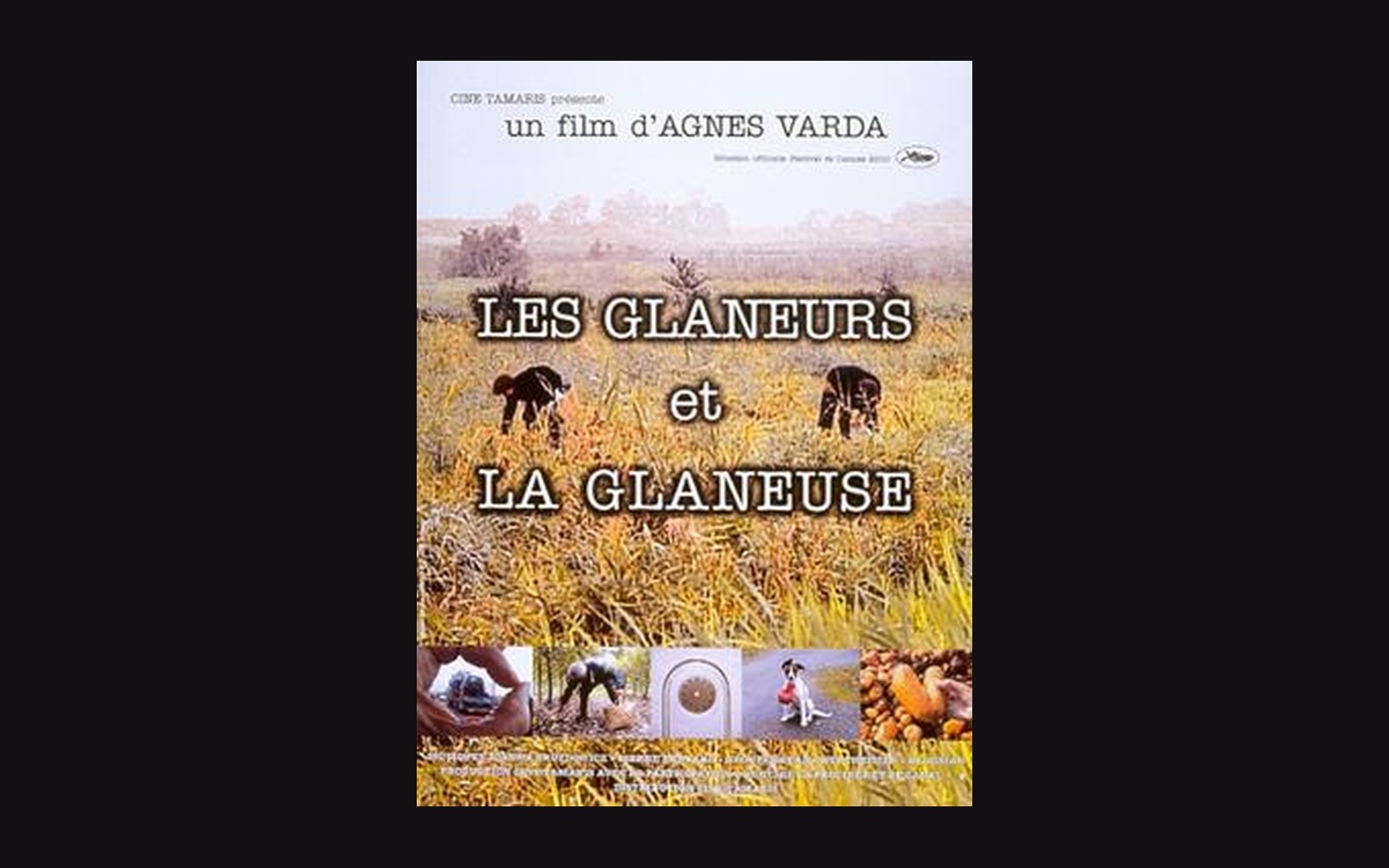
Varda took her title from the Millet painting and a camera she could hold in one hand into the fields.
Varda's Camera in Her Own Hand
The Gleaner Who Filmed the Gleaning
Jean-François Millet's The Gleaners (1857) appears early in Les glaneurs et la glaneuse (2000) — Varda's gloss, in English: The Gleaners and I — as a painting on a museum wall, then as a postcard, then as a detail blown up until it dissolves into pigment. The gesture is deliberate: Varda is establishing that gleaning, the ancient practice of gathering what harvests leave behind, is also what she is doing with her camera. The DV camera. A Sony consumer camcorder small enough to hold in one hand, light enough to swing toward a mirror and point at herself.
That self-pointing is the film's central innovation. Shooting her own hand, spotting her age spots, holding her palm up against a sky full of trucks on a motorway overpass — Varda turns the camera's portability into a philosophical act. The hand that gleans and the hand that films are the same hand, and the film is a meditation on that coincidence. No earlier first-person documentary had quite so literally collapsed the distance between filmmaker and instrument. The essay film had always included the filmmaker's voice and sensibility; Varda included the filmmaker's body, filmed by herself, in real time, without a crew mediating the image.
What the digital consumer camera made available was not just lightness — Direct Cinema had solved lightness forty years earlier — but intimacy without infrastructure. Varda drove through post-harvest fields in France, filmed potato gleaners and urban scavengers and artists who built sculptures from rubbish, and turned the camera on herself between takes, capturing stray thoughts the way a notebook captures marginalia. The resulting register is warmer and more provisional than anything sync-sound 16mm encouraged, because the cost of a digital minute approached zero and the presence of a sound recordist approached none.
The Millet painting also signals something about class and dignity that the film carries through: gleaners were the poor; gleaning was legally protected in France under the droit de glanage (the right to glean). Varda treats her own aging — her white hair, her spotted hands — with the same unsentimental curiosity she brings to those who survive by gathering. The camera in her own hand is not a weapon or a mirror in any vain sense; it is an instrument of attention, turned inward only so the film can then turn it outward, with more honesty about who is doing the looking.
Read next in Essay Film