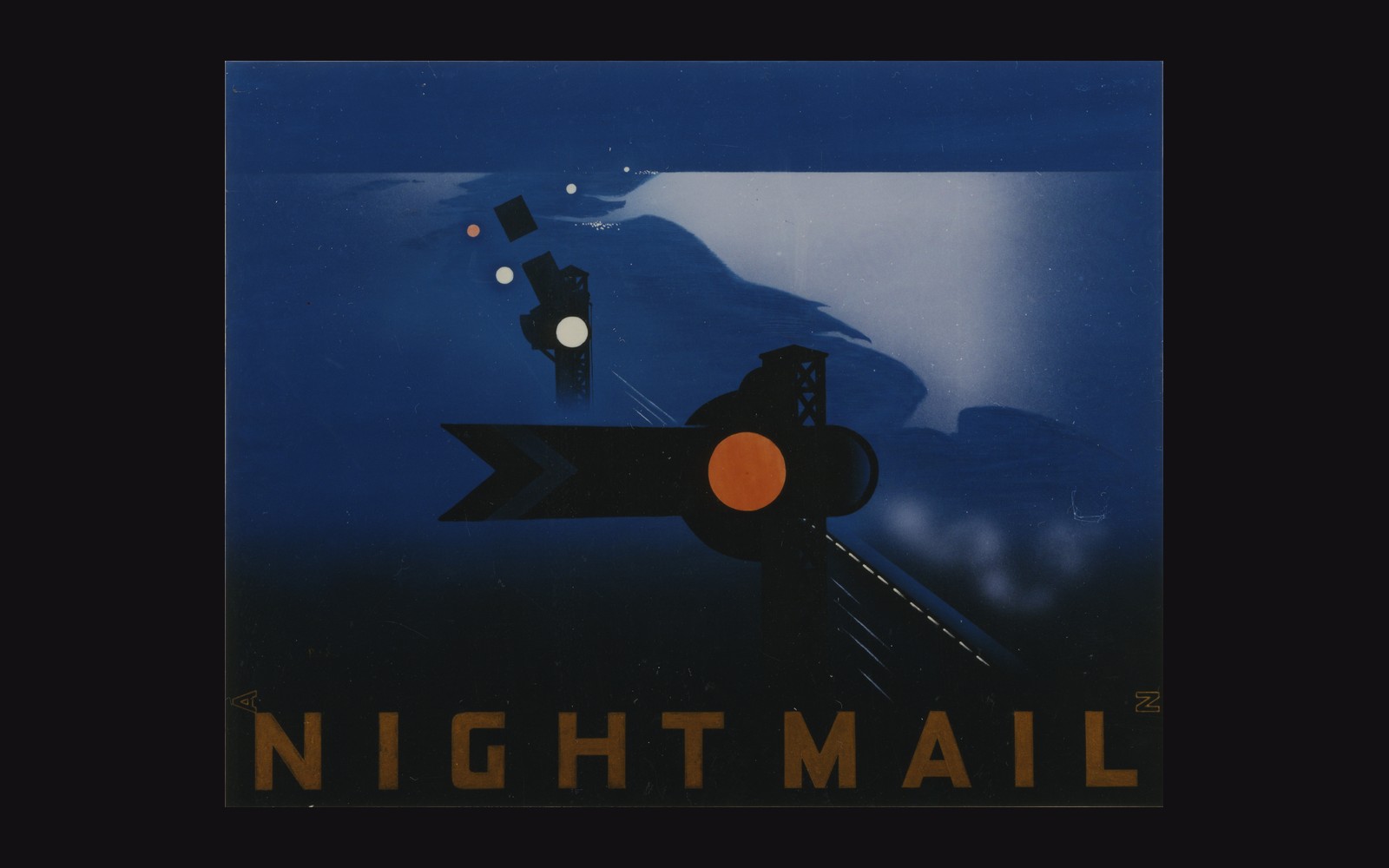
The Post Office advertised a mail train and released a poem cut to Britten's score.
The Sorting Carriage at 2 a.m.
A film that found its rhythm in the cutting room, not on the page
Night Mail (1936) is about twenty-four minutes of postal logistics transformed, somehow, into a minor poem of national life. Directed by Basil Wright and Harry Watt for the GPO Film Unit, it follows the Travelling Post Office train on its overnight run from London to Glasgow — the sorting of letters, the mechanical exchange of mail bags at lineside apparatus, the fireman's shovel, the pre-dawn quiet of the Caledonian hills. What lifts it from instructional filmmaking into something else is the final sequence, in which W. H. Auden's verse and Benjamin Britten's percussion score lock onto the images with the precision of sprocket holes on a flatbed editing table.
The film began as a practical commission. The GPO Film Unit, established in 1933 under John Grierson's supervision, existed to interpret government services to the public — Grierson's phrase "creative treatment of actuality" applied here in its most literal sense. The Travelling Post Office was an ideal subject: a process that was visually rich, rhythmically varied and genuinely unfamiliar to most of the audiences who depended on it.
How the verse was made to fit
Wright and Watt shot on location and in the studio, combining handheld footage aboard the moving train with carefully composed sequences of sorters working the letter frames. The editing was conventional by the time it reached the final sequence — but that sequence required something more. Grierson had already worked with Auden on several short films, and Auden was brought in to write verse that would carry the final reel's images of train, track and approaching dawn. The problem was that the images existed before the words did.
This is the detail that matters: Auden wrote his lines to a rough cut, not the other way around. The footage was assembled, its duration fixed, and Auden had to make his stresses and syllables fit what the editors had already built. Britten then scored beneath both, his percussion mimicking the train's acceleration and the clatter of wheels at junctions. The collaboration was, by every account, genuinely collective — three artists working in the same Soho cutting room, adjusting to one another's constraints in real time.
The result is a piece of verse that reads adequately on the page ("This is the Night Mail crossing the Border, / Bringing the cheque and the postal order") but becomes something else entirely when spoken over Britten's insistent rhythms and the images of a locomotive climbing into Scotland. The verse scan is not literary; it is cinematic — built on the duration of shots, not on any prior prosodic intention. Auden reportedly revised lines on the spot when they ran too long or broke at the wrong syllable. What survives is not a poem illustrated by film but a poem that could only exist because of film.
Chronology
- 1933GPO Film Unit established under Grierson
- 1935Housing Problems (Anstey, Elton) — the unit's plainest observational mode
- 1936Night Mail released; poetic mode; BFI restored print held
The Unit's method, in miniature
Night Mail is the GPO Film Unit's most enduring work for a reason: it is also its most self-conscious demonstration of what the unit believed film could do. Edgar Anstey and Arthur Elton had made Housing Problems the previous year with a deliberately plain style, letting tenement dwellers speak directly to the camera in some of documentary's earliest on-screen testimonies. Wright and Watt took the opposite approach — shaping material into argument through rhythm and form rather than through witness. Both impulses were present in the Grierson project, and both remain live in documentary practice today.
The BFI holds a restored print, and the film is routinely shown as the foundational example of the poetic documentary mode. Its influence runs from Humphrey Jennings — whose Listen to Britain (1942) extended the same logic of associative sound and image — through to any contemporary documentary that trusts editing rhythm over expository narration. The specific lesson Night Mail teaches is still the hardest one for filmmakers to learn: that images assembled in time create their own demands, and the writer's job is to meet them, not to override them.
Read next in Grierson