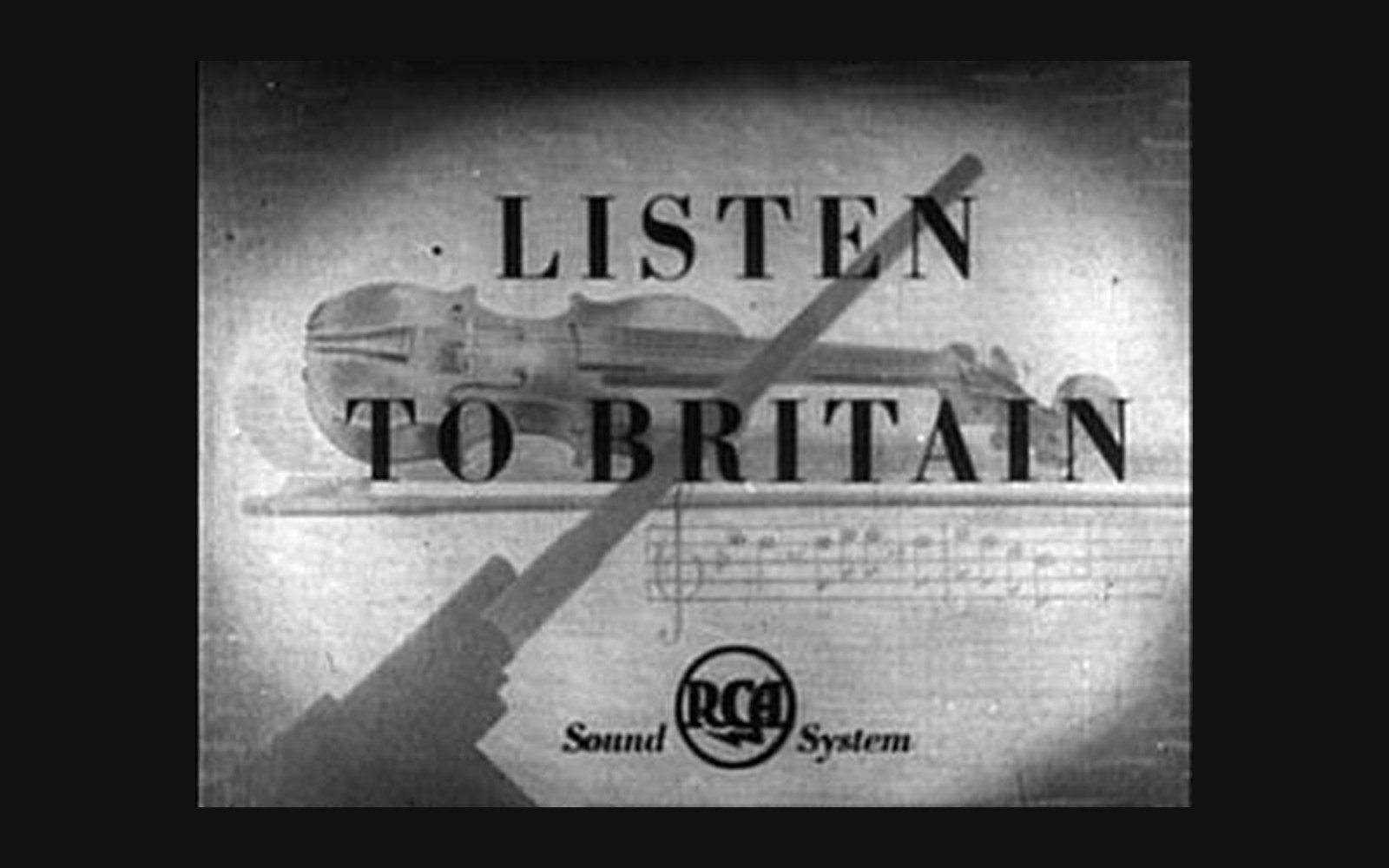
The title card promises sound, and the film delivers nothing else — no commentary, no narrator, no thesis.
Jennings Made No Argument
Listen to Britain and the documentary that refused to explain itself
Humphrey Jennings shot Listen to Britain in 1942 for the Crown Film Unit, and it runs for barely twenty minutes. It carries no commentary, no narrator, no thesis sentence, no instruction about what the viewer is supposed to feel. For a government film made in the middle of a war, that was not an obvious choice — it was a provocation.
The Crown Film Unit existed to make the case for Britain. Its films had purposes: to sustain morale, recruit workers, explain rationing. The received model, shaped by John Grierson's insistence on the "creative treatment of actuality" — his phrase for documentary's power to interpret the real world rather than merely record it — depended heavily on the spoken word. Grierson trusted the authoritative voice because he trusted argument. His GPO Film Unit films, and the Crown films that followed, typically placed a narrator between the audience and the image, translating what the eye was seeing into meaning.
Jennings removed that translator.

The Sound That Does the Work
Listen to Britain is organised not around argument but around sound. RAF men and women dancing at a canteen. Workers singing in a factory. Children's voices. A lunchtime concert at the National Gallery — Myra Hess at the piano, the Queen in the audience, bomb-damaged London outside. The soundtrack moves between these things with the logic of memory rather than rhetoric, one acoustic texture dissolving into another. The film's thesis, if it has one, exists in the editing pattern: this is what Britain sounds like, and the variety of that sound is itself the argument for why it matters.
The approach came from Jennings's other life. Before the war he had been a painter, a poet and a founding organiser of Mass Observation, the social research project that recorded the texture of everyday British life — its conversations, its habits, its surfaces — without interpreting what it found. He was also a committed Surrealist, drawn to the essay-film sensibility that distrusted direct statement. For Jennings, juxtaposition was more truthful than commentary. Images and sounds placed beside each other create a resonance that a narrator can only flatten.
Stewart McAllister, his editor, was essential to that argument-without-words. The cuts in Listen to Britain are not explanatory — they do not say "this is why." They are associative. A harvesting machine in a field gives way to an anti-aircraft gun on a clifftop, and the similarity of their silhouettes does the work that a line of commentary would have done clumsily. The film trusts the audience to complete the circuit.
What Grierson Couldn't Accept
Grierson did not entirely trust it himself. His reported view of Listen to Britain was that it was irresponsible without a frame — that without context, beautiful images of wartime Britain became aestheticised rather than purposeful. The objection was principled: documentary, for Grierson, was a civic form with obligations, and obligations required articulation.
Jennings's counter-position was never written as theory. He left no manifesto equivalent to Grierson's critical essays. What he left was the films themselves — Words for Battle (1941), Listen to Britain (1942), Fires Were Started (1943), A Diary for Timothy (1945) — each one pushing further toward a documentary that operates through feeling rather than through declaration. Fires Were Started in particular extends this into narrative, following an Auxiliary Fire Service crew through a single shift, and is widely considered one of the finest British films of the Second World War.
Listen to Britain stands apart because it is the purest test of the method. No story, no commentary, no characters introduced by name: just Britain at sound. The film demonstrated that a documentary could make its audience feel a country rather than understand a policy — and that this was not a lesser achievement but a different one. Whether Grierson was right that documentary owes the audience an argument, or Jennings was right that it owes the audience an experience, is a dispute that has never resolved. It is still the central dispute.
Read next in Free Cinema