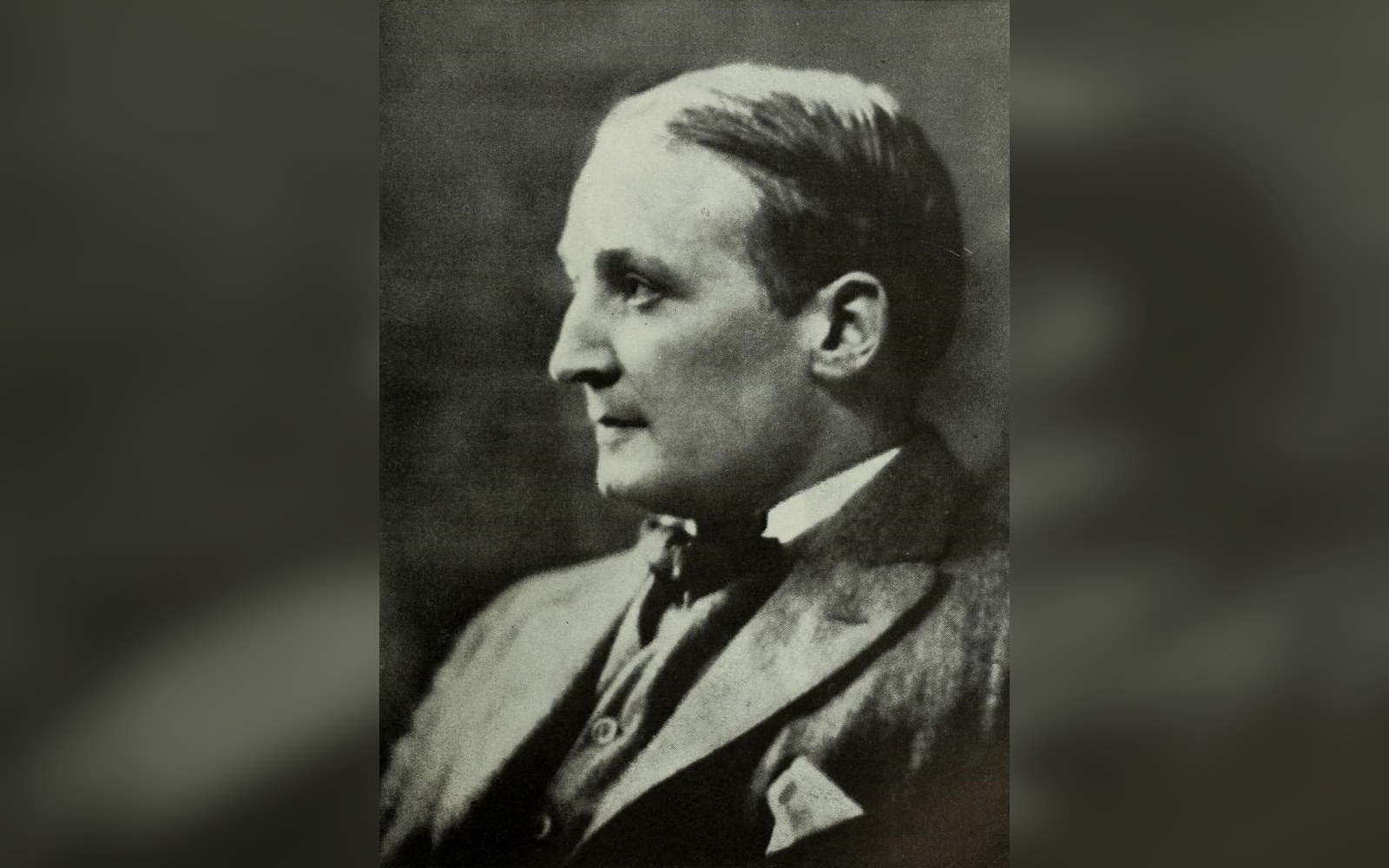
Pathé's 1922 release sheet sells the Arctic as spectacle — the word documentary had not been coined yet.
Flaherty at the Ice Hole
The first documentary was also the first argument about what a documentary could be: Flaherty's Nanook of the North staged the life it claimed to show.
Robert Flaherty arrived at Inukjuak, on the eastern shore of Hudson Bay, in August 1920 with a commission from the fur-trading company Revillon Frères, roughly nine thousand feet of raw film stock and a fixed belief that the Inuit were vanishing. The belief was wrong — the Inuit were not vanishing — but it shaped every frame of what became Nanook of the North (1922), a film that claimed to show life as it was lived while systematically staging the life it claimed to show. That tension has never been resolved, and it is precisely why the film still matters.
Flaherty had been in the region before. Earlier trips in the 1910s had produced footage, including roughly thirty thousand feet of negative that he accidentally destroyed by dropping a cigarette onto the film. The loss was catastrophic but clarifying: he returned for the 1920 shoot knowing he wanted a single narrative subject, a man whose life could carry the film's argument about survival. The man he chose was a hunter the Inuit called Allariallak; Flaherty called him Nanook. The two women presented as Nanook's wives were not his wives. The kayak scenes were faked. The walrus hunt was real.
What Revillon Frères Paid For
The commission mattered enormously to the film's character. Revillon Frères, a French fur company competing with the Hudson's Bay Company for trade in the Canadian north, wanted footage that could be screened in theatres to raise the profile of their enterprise. They were not funding a neutral record. What they wanted — and broadly got — was an image of the north as a wild, harsh, barely penetrable place where a man of extraordinary skill and endurance wrested a living from the ice. That image served their commercial narrative about the value of what they traded in. The fact that by 1920 the Inuit at Inukjuak had been trading with Europeans for decades, using rifles rather than harpoons and engaging with a cash economy, was inconvenient. Flaherty asked Allariallak to hunt with a harpoon on camera even though he owned a rifle. The harpoon sequence is the film's moral centre and its central fabrication simultaneously.

This is not a footnote to the film's history; it is the film's history. Flaherty did not deceive his subjects — he collaborated with them, showing his rushes to the community and adjusting his approach on the basis of what they thought worked. He built a half-igloo, open on one side to allow winter light, so that the interior scenes could be filmed at all. He was transparent with his subjects and opaque with his audiences. That asymmetry is the foundational problem of the form he invented.
The Walrus Hunt, Four Minutes, Every Frame Contested
The walrus hunt sequence is the most debated four minutes in documentary history not because of what Flaherty did to stage it but because, as far as anyone can establish, he did not stage it at all. The hunt at Cape Dufferin took place, the walrus was real, and the danger was real. Flaherty filmed a group of hunters pursuing a bull walrus onto an ice floe, wrestling it with harpoon lines as it attempted to drag them into the water. The camera was close enough that its position required the same nerve as the hunt itself.
What makes the sequence strange to modern eyes is not its authenticity but its editing, which is unmistakably theatrical. Flaherty cuts between close-ups of straining faces, wide shots of the tug of war with the animal, and reaction shots of watching figures on the shore — cuts that construct suspense exactly as a fictional film of the period would. The intertitles call Nanook "the great hunter" and frame the outcome as a matter of individual heroism. The communal, technical reality of Inuit hunting — in which success depended on shared knowledge and distributed effort across a large group — is compressed into a two-character drama. The facts are real. The framing is myth.
Chronology
- 1910sFlaherty's earlier filming expeditions to Hudson Bay; accidental destruction of footage by cigarette fire
- August 1920Flaherty arrives at Inukjuak; Revillon Frères commission begins
- 1922Nanook of the North opens in New York, released by Pathé; Allariallak dies the same year
- 1989Film selected for the inaugural Library of Congress National Film Registry class
John Grierson, who saw the film after it was released and would later coin the phrase creative treatment of actuality to describe what documentary could legitimately do, understood immediately that Flaherty had solved a problem no one had fully faced before: how to make real life gripping without making it up. Grierson's phrase, with its deliberate ambiguity about how much treatment was creative licence and how much was distortion, owes its elasticity directly to what he saw at the walrus hole.
Document and Construction, Both at Once
The film that opened in New York in June 1922 to wide critical acclaim was released by Pathé after Paramount had turned it down, reportedly on the grounds that audiences would not pay to watch a film with no story. Pathé's instinct proved right: the film was a commercial success, and its success created the template for every expedition documentary that followed — the white filmmaker in an extreme environment, the indigenous subject presented as noble, the survival narrative as the spine.
Nanook of the North is held in the Library of Congress National Film Registry, having been selected in the inaugural 1989 class on the grounds of its cultural, historical and aesthetic significance. That designation carries its own irony: the film is preserved as a national treasure by a nation whose territory does not include Inukjuak, which is in Quebec. The Inuit community at Inukjuak have their own complex relationship with the film's legacy, one that includes justified critique of its paternalism and a parallel recognition that the footage constitutes a rare visual record of early twentieth-century Inuit material culture — the construction of the igloo, the seal-hunting technique, the tools — at a moment before those practices had been substantially altered by sustained contact with the south.
Allariallak died soon after the film was released, likely of starvation during a winter hunting season. Whether this happened because the hunt had genuinely become harder, or for reasons unconnected to any trend, is not known. Flaherty was not there. He had returned south to edit his footage in New York, constructing from roughly forty hours of material a seventy-nine-minute film that made Allariallak — renamed, reimagined, turned into a universal figure of the heroic primitive — internationally famous. Fame that arrived too late for the man himself to know about it, in a language he did not speak, in cities he had never seen.
What survives, then, is a film that cannot be taken at face value and cannot be dismissed. The walrus is real. The harpoon was chosen over a rifle for the camera's benefit. Allariallak's skill as a hunter was not invented: the film records genuine capability, even as it frames that capability within a fiction of timelessness that had already expired. The ice hole was real. The performance at the ice hole was also real. Both things are true, and the form Flaherty invented has been arguing about them ever since.
Read next in Silents