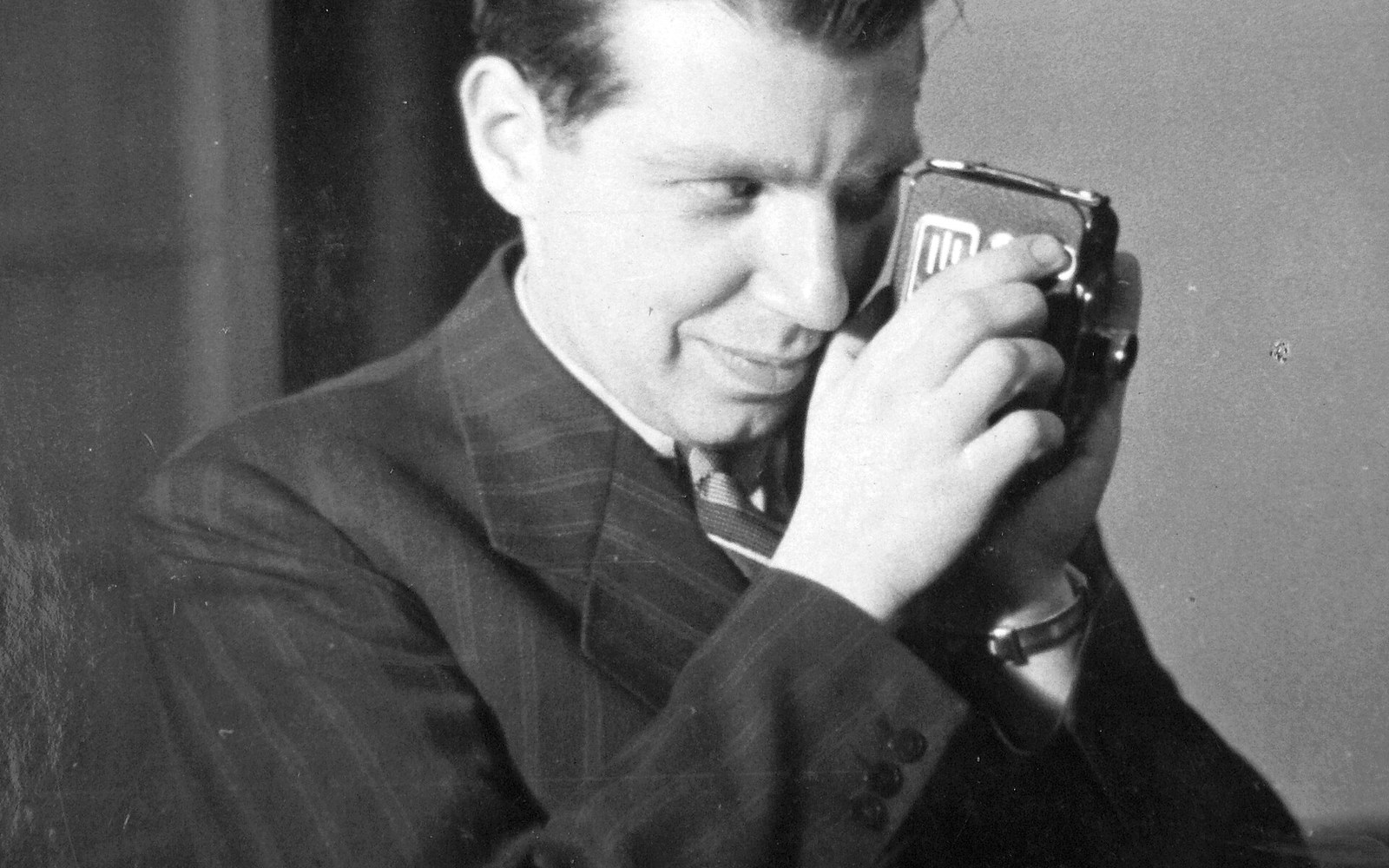
A period portrait of the machine Vertov made his subject: a hand-cranked camera held at eye level.
Vertov's City, Shot in Three
The Composite City
One film, three cities, no narrative: how Dziga Vertov and Mikhail Kaufman assembled a Soviet metropolis from footage gathered across Moscow, Kyiv and Odesa
Man with a Movie Camera arrives in 1929 as a film that refuses to be set anywhere in particular — which is precisely the point. Dziga Vertov shot across three Soviet cities over several years, with his brother Mikhail Kaufman as the film's primary cameraman, and then edited the material into a single, unnamed urban organism. Streets in Moscow give way to beaches in Odesa; a factory interior from one city cuts to a tram junction in another. The resulting metropolis exists only on the flatbed, assembled from the rhythms of industrial life rather than from geography.
Vertov called his governing principle the kino-eye: the argument that the mechanical camera perceives reality more truthfully than the human eye, freed from sentiment, habit and biological limitation. Where conventional cinema borrowed the grammar of theatre, kino-eye would construct meaning through pure montage — the collision of images rather than their smooth continuity. Man with a Movie Camera is the fullest demonstration of that theory, and its composite city is the theory's first demand. No single city could supply, in the right sequence and at the right time of day, the images Vertov needed. So he took what each city gave him and cut it into a single accelerating argument about modern life.
Kaufman in the Frame
The film does something unusual with its own making: it shows it. Mikhail Kaufman appears throughout, a camera mounted on a tripod at strange angles, lowered onto railway tracks, hoisted above crowds. The film opens in an empty cinema, then cuts to the editing room, where Elizaveta Svilova — Vertov's wife and the film's actual editor — handles strips of celluloid at the table. This is not a prologue; it is a structural declaration. The audience is being told, from the first reel, that film is constructed, that the camera is a physical object held by a human body, and that the sequence of images they are about to watch has been chosen and arranged.
The reflexive strategy culminates in a sequence where the cameraman's reflection appears in the lens of his own camera. It is a moment of deliberate dizziness: image inside image, the technology folding back on itself. For Vertov this was not a formal trick but a philosophical claim — the kino-eye sees its own seeing, unlike the human eye, which cannot. The shot also anchors the film's central fiction: that there is a single "man with a movie camera" moving through this city, when the real production involved multiple operators, multiple cities and years of effort.
Montage as Argument
The split-screen intersection sequence arrives roughly mid-film and condenses the kino-eye method into a minute or two of organised astonishment. Traffic flows from multiple directions, the frame divides, and the viewer is asked to hold several simultaneous streams of motion — trams, pedestrians, carts — as a single perceptual event. No narrative drives the cut; rhythm does. Vertov and Svilova increase the tempo as the sequence builds, shortening shots until the edit itself becomes a kind of acceleration.
This is the aesthetic principle translated into practice. Grierson's phrase "creative treatment of actuality" would not be coined for another few years, and Vertov would have rejected its gentleness in any case; his treatment was more like a controlled collision. The film's second half moves from dawn through the working day and into leisure — swimming, beer halls, football — and the editing keeps pace, the city's metabolism rendered as montage rhythm rather than as story.
What gives Man with a Movie Camera its permanence is not the archival record of Soviet urban life in the late 1920s, though that is real and extraordinary. It is the rigour with which Vertov thought through what the camera could do that a novel or a painting could not: record duration, manipulate speed, divide the frame, make visible the machinery of its own recording. The editing room as subject is not a modernist flourish but a statement of belief — that honesty about construction is the only honest documentary method.
Read next in Silents