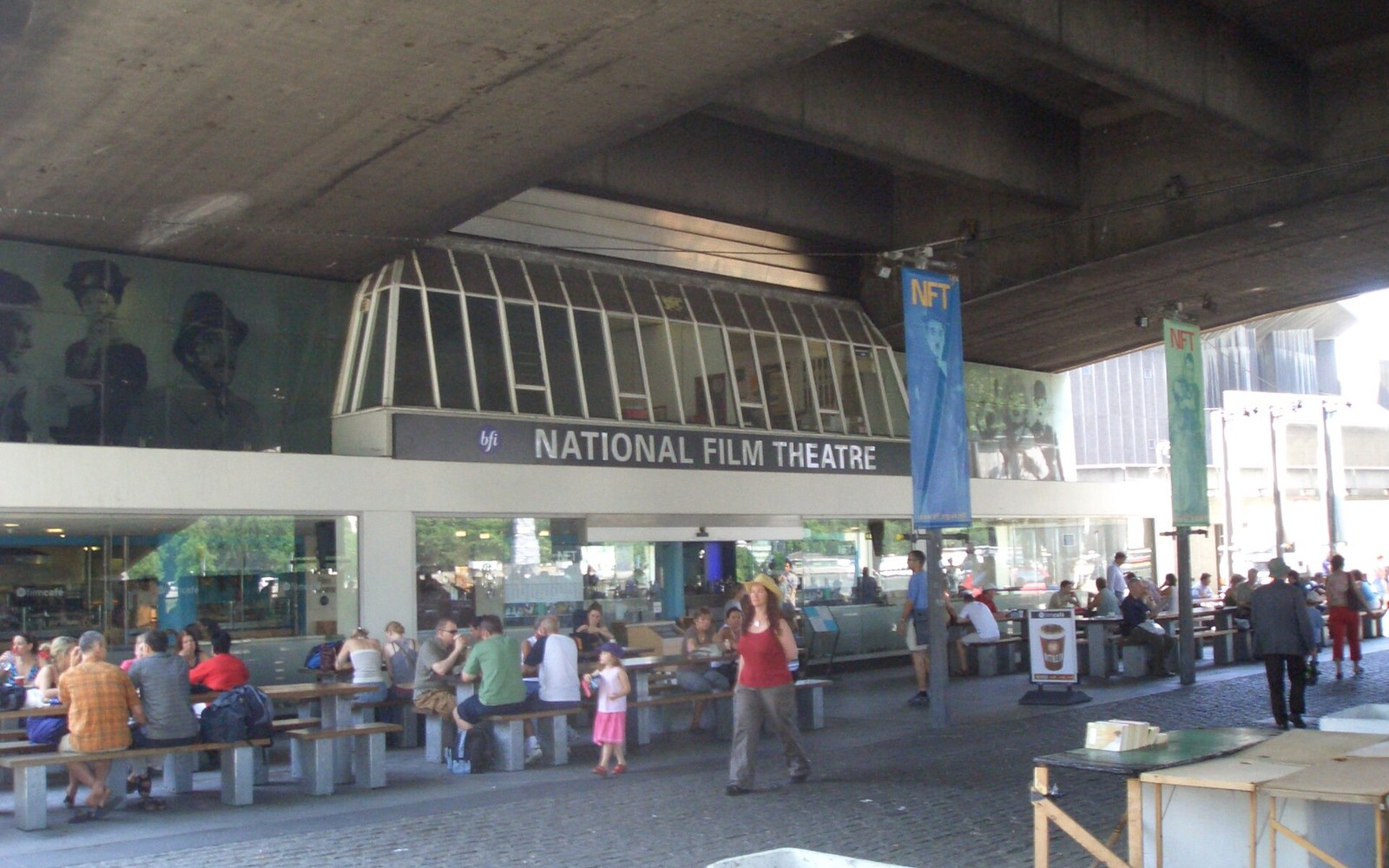
Six programmes at the National Film Theatre between 1956 and 1959, each with a manifesto pinned up at the entrance.
Six Programmes at the NFT
A Bulletin at the Door, a Movement on the Screen
Between February 1956 and March 1959, six programmes of short films played at the National Film Theatre, London under the collective heading Free Cinema. The series was organised principally by Lindsay Anderson, Karel Reisz and Tony Richardson, with the Italian-born filmmaker Lorenza Mazzetti joining as a fourth voice on the first programme. No funding body commissioned it, no institution sponsored it into existence. What the three British filmmakers shared was a conviction that their country's cinema had turned its face away from the lives ordinary people actually lived, and that the documentary form — small-gauge, inexpensive, liberated from the prestige obligations of the feature industry — was the tool best suited to looking back.
The manifesto posted on a board at the NFT entrance was brief and deliberate. It announced that the films shown under the Free Cinema banner were "not neutral" — that "no film can be." It insisted that "an attitude means a style" and that "a style means an attitude." It named "the fragmentary, the unheeded" as legitimate subjects. In fourteen lines it positioned these films not as journalism, not as sponsored information, but as acts of personal commitment made without commercial obligation. The wording was Anderson's, though all four signatories endorsed it. The text survived because the BFI archived the original programmes, and it still reads as a compressed statement of what documentary could be asked to carry.
The Three Films That Made the Case
The first programme, on 5 February 1956, included three films that functioned as an argument by example. Anderson's own O Dreamland (1953) had been shot at a Margate amusement park on a single day with a borrowed camera, no crew and no synchronised sound — the voice of the park's mechanical attractions laid over images of fairground crowds eating, staring, pulling at machines. The targets are not subtle: a wax tableau of a man being hanged, the bored faces of onlookers, the mechanical violence of penny rides. Anderson edited the film in a year characterised elsewhere by Cinemascope prestige productions and offered it as a counter-image: this is where people go when they are briefly free, and this is what they find. The film ran fourteen minutes and cost almost nothing. Its economy was the point.

Reisz and Richardson's Momma Don't Allow (1956), also on that first programme, worked differently. Shot over several weeks at a jazz club in Wood Green, north London, it used the Humphrey Jennings–trained instinct for finding the telling social fragment in a crowd and applied it to a generation that Jennings had never filmed. The musicians play, the young customers drink and dance, the camera moves in close enough to catch the self-consciousness of performance — on the bandstand and on the floor. A group of upper-class gate-crashers arrives; the edit makes the collision of registers plain without a word of commentary. Momma Don't Allow had sync sound and showed its workings. The ambition was modest by feature standards; by the standards of what British documentary was offering in 1956, it was practically insurgent.
Anderson completed the series' signature film the following year. Every Day Except Christmas (1957), made with support from the Ford Motor Company's short film programme and produced by Leon Clore, followed the overnight workers at Covent Garden market through a single night shift. Shot by Walter Lassally, who would become one of Free Cinema's indispensable technical collaborators, the film used available light with a discipline that made the warehouse interiors glow rather than merely record. The workers are not explained or contextualised. The commentary is sparing, and it leaves the images to carry the film. Anderson's statement on the film described the intention as "a feeling of respect" for the subjects — a phrase that, set beside the Griersonian tradition of working-class subjects as problems to be solved or types to be illustrated, carried real weight. The film won the Grand Prix for short documentary at Venice in 1957.
Five More Programmes, a Wider Frame
The subsequent five programmes, running through 1957, 1958 and into 1959, expanded the series beyond its founding trio. Programme Two (July 1956) brought in work from Poland and France; the series never restricted itself to British films and was the stronger for it. The decision to include Jean Vigo's À propos de Nice (1930) — Vigo being a figure the organisers treated as a presiding spirit of socially committed personal filmmaking — announced a genealogy. It placed Free Cinema inside a longer history of cinema made against the grain of commercial expectation and national self-congratulation.
Later programmes included films by the French documentarian Georges Franju and work from the National Film Board of Canada, and a programme devoted to American documentary. The organisers were explicit that they were not founding a school. Each film screened was chosen because it shared a quality — of directness, of commitment, of finding the specific and the particular rather than the general and the illustrative — rather than a method or a nationality. What united the six programmes was the manifesto's insistence on attitude, and the practical fact that all the films had been made outside commercial systems that would have required them to be something other than what they were.
The Free Cinema label itself ran for three years and six programmes and then, by mutual agreement, stopped. Anderson, Reisz and Richardson each moved into feature filmmaking: Reisz made Saturday Night and Sunday Morning (1960), Richardson The Loneliness of the Long Distance Runner (1962), Anderson This Sporting Life (1963) — a set of transitions that placed them at the centre of British New Wave fiction and left the documentary work behind. The question of whether Free Cinema caused the New Wave or whether the same generation simply produced both remains genuinely open.
What stayed was the manifesto, and what the manifesto had licensed. The argument that a film could be made by one person or two, on money raised by indirection, about people who were not being managed or explained, and that the result could be shown in a serious cultural venue as cinema rather than as illustrated sociology — that argument did not need to be remade every time after 1959. The BFI's preservation of the original six programmes means the films themselves are still available for the argument to be tested against, and the testing holds up. O Dreamland remains more disquieting than most British documentaries of its decade. Every Day Except Christmas is still one of the most technically assured observational films produced in Britain before lightweight sync-sound equipment changed the terms of what was possible. The manifesto was fourteen lines. The films were the evidence.
Read next in Free Cinema