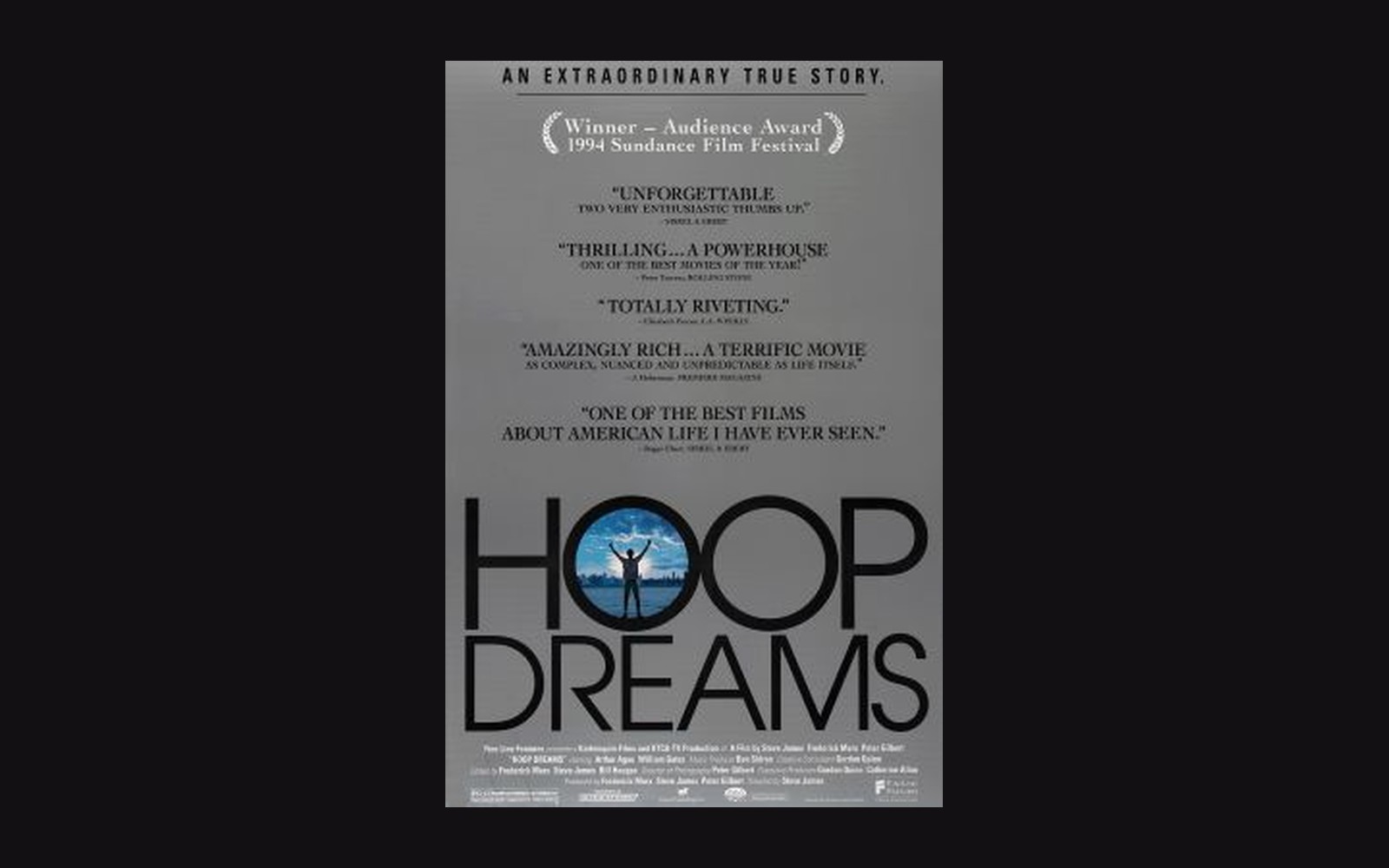
One hundred and seventy minutes, five years of filming, and no nomination in the documentary category.
Five Years, Two Families, One Camera
Hoop Dreams and the Documentary That Ran Longer Than the Game
Steve James, Frederick Marx and producer Peter Gilbert began following Arthur Agee and William Gates in 1987, when both boys were entering the basketball pipeline at St. Joseph High School in Westchester, Illinois — a predominantly white Catholic institution sixty minutes from their South Side Chicago homes that had produced NBA star Isiah Thomas. What they originally conceived as a thirty-minute short for PBS grew, over five years of continuous access, into a 170-minute theatrical feature that remains one of the most formally ambitious American documentaries ever made.
The length was not a failure of editing discipline. It was the argument. Hoop Dreams (1994) accumulates enough time with Agee and Gates — through injuries, financial collapse, school transfers and family crises — that the viewer experiences something close to the actual texture of sustained hope deferred. No précis of the material would have produced the same effect. The film's three-hour shape is inseparable from its subject: the peculiar cruelty of a sports-industrial system that recruits Black children from poor neighbourhoods, extracts their talent and discards most of them before they reach adulthood.
Sundance, the Critics, and the Academy
Hoop Dreams premiered at the Sundance Film Festival in January 1994, where it won the Audience Award. Fine Line Features acquired it for theatrical release, and the critical response was extraordinary: the film appeared on more year-end top-ten lists than any other American release, and Roger Ebert called it one of the greatest films he had ever seen. The Chicago Film Critics Association named it the best film of the year — not the best documentary, the best film.
Then the Academy of Motion Picture Arts and Sciences failed to nominate it for Best Documentary Feature. The Documentary Branch's nominating process at the time required films to pass through a small screening committee before reaching the full branch vote; Hoop Dreams did not survive that filter. The snub provoked enough public outcry that the Academy subsequently revised its nomination procedures, though the changes came too late for James, Marx and Gilbert.
The irony was structural. The very qualities that made the film extraordinary — its length, its narrative complexity, its resistance to the redemptive arc that documentary juries often reward — apparently worked against it in a room of voters habituated to shorter, more conventionally shaped work.
What Five Years Actually Required
Peter Gilbert shot the film himself, accumulating roughly 250 hours of 16mm and video footage. The scale of that undertaking imposed obligations beyond the logistical. Both families — the Agees and the Gateses — lived with a camera presence across some of the most vulnerable episodes of their lives: a father's drug addiction, a utility shutoff, a career-threatening injury. The ethical weight of that access never fully disappears from the finished film; you feel it in the way James frames setbacks, never exploiting them but never sanitising them either.
The editing, led by James with Marx and Bill Haugse, took roughly a year. Compressing 250 hours to 170 minutes while maintaining the sense of unfolding time — rather than summarised time — is a problem of documentary construction that has few precedents. The film works in part because the editors trusted duration: the slow accumulation of detail that makes an audience genuinely care what happens in a gymnasium in a way that no highlight reel could manufacture.
Hoop Dreams sits in the tradition of observational documentary that Frederick Wiseman established — rigorous, institutionally focused, long — but where Wiseman typically withholds individual psychology behind behaviour, James commits to interiority, to the faces of two young men carrying the projections of coaches, scouts, parents and a viewing public that would rather watch a myth than acknowledge a system.
The film was eventually preserved in the Library of Congress National Film Registry in 2005. That it took a decade suggests how long it can take for the obvious to become official.
Read next in Makers