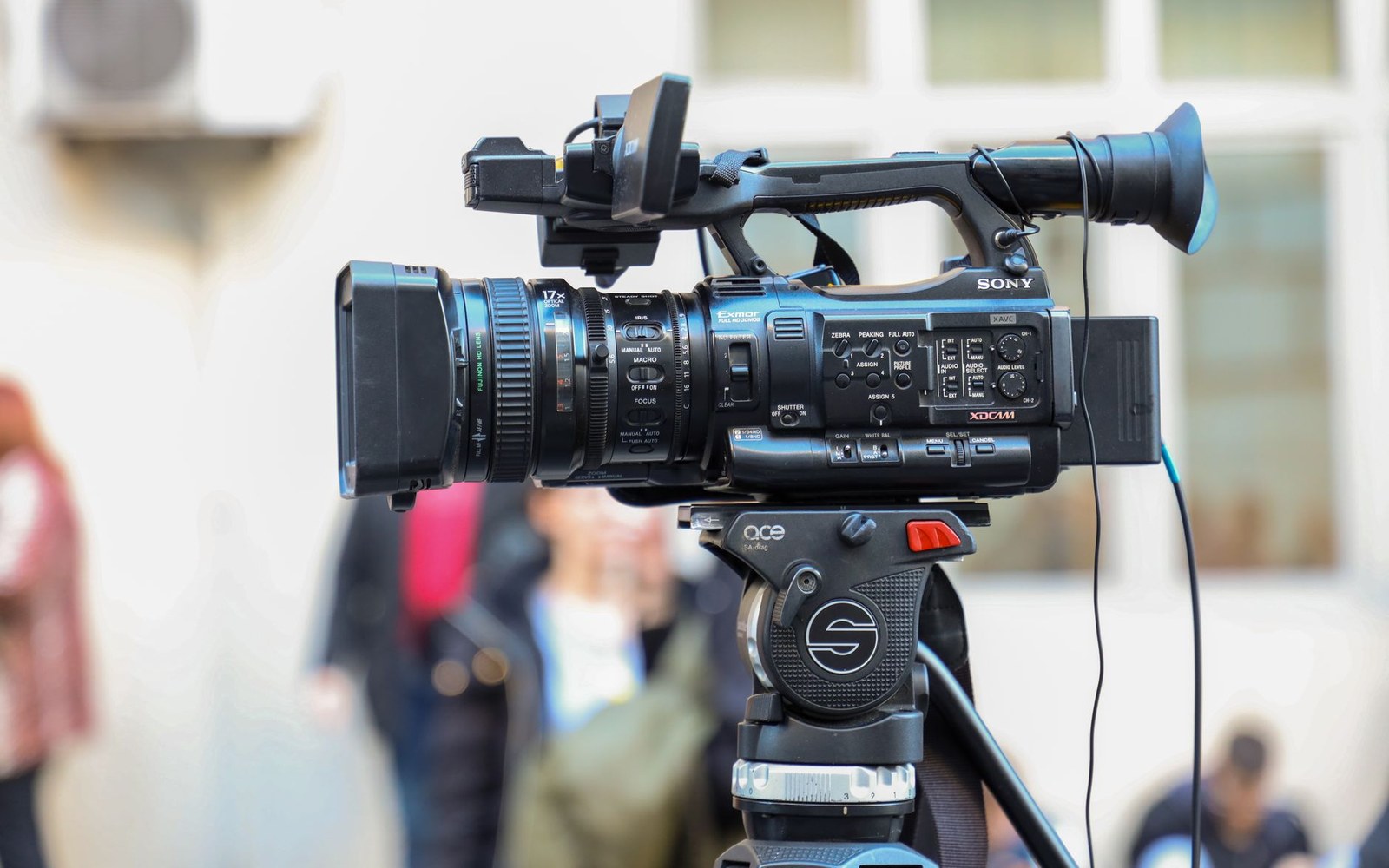
A shoulder-held camcorder of this generation put the form in reach of anyone with a tripod and a year.
The Camera in Everyone's Hands
Tape Unlocks the Form
How cheap tape and a full-frame sensor rewired who got to make a documentary
Before DV, the gatekeepers were technical. Shooting on 16mm cost money at every stage — stock, processing, telecine — and the cameras themselves were tools of institutions. When Sony released the DSR-PD150 in 2001, building on the consumer DV formats that had been spreading since the mid-1990s, the arithmetic of documentary production changed overnight. A camera that delivered broadcast-acceptable images retailed for around four thousand dollars. Tape was cheap. There was no processing lab between the filmmaker and the footage.
The aesthetic consequences arrived quickly and were not all welcome. DV produced a particular look — shallow latitude, slightly cold whites, the characteristic smear of fast motion — that became so associated with urgency and authenticity that it was sometimes faked by filmmakers working on larger budgets. The grain of 16mm had carried its own authority; the pixelated shimmer of compressed digital video carried a different one, closer to news, closer to witness. Directors who had come up through the Direct Cinema tradition found the lighter cameras congenial. Directors making their first films found them indispensable.
The practical freedom was enormous. Barbara Kopple had spent thirteen months in Harlan County with a crew; a filmmaker with a PD150 could work alone, shoot for hours without a reload, and not flinch at the cost of a difficult or uncertain day. Hoop Dreams had been shot on Hi-8 and 16mm — a hybrid that signalled the direction of travel even before DV stabilised as a format. By the early 2000s, the Sundance Film Festival and Sheffield DocFest were thick with work that would not have existed without the cost collapse. Some of it was formally loose in ways that mattered; much of it was formally loose in ways that did not. Access had democratised; discrimination had not automatically followed.
What the 5D Did to Light
The second rupture came in 2008 with an unlikely instrument. Canon designed the EOS 5D Mark II as a still camera; the full-frame CMOS sensor capable of recording 1080p video was almost an afterthought. What it delivered in practice was something documentary had never previously had at that price point: the depth-of-field control of a cinema camera, the low-light sensitivity of a fast prime lens on a large sensor, and a body small enough to carry into spaces where a film crew would be refused entry. The glass — Canon L-series lenses, Zeiss primes adapted to the EF mount — became the real conversation. A documentary could now look like a feature film without a feature film's lighting budget.
The arguments this opened were genuine. Shallow depth of field, which the 5D delivered almost by default, is a compositional decision with meaning: it isolates subjects, blurs context, flatters faces and can aestheticise material that resists aestheticisation. Critics noted that the camera's beautiful images sometimes worked against honesty rather than toward it. Defenders pointed out that the alternative — the slightly clinical sharpness of earlier video formats — was itself an aesthetic choice, not a neutral one. The 5D did not resolve this argument. It made it unavoidable.
Three Steps, One Argument
Set the two moments beside the earlier transition they echo — the Éclair NPR and Nagra III enabling sync-sound shooting in 1960 — and a pattern emerges. Each technology step lowered the threshold of entry and raised the threshold of formal decision-making. Portable sync sound gave Direct Cinema its philosophical premise: that the camera could witness without distortion. DV gave individual filmmakers the same physical freedom at a fraction of the cost, but removed the institutional context that had, however imperfectly, filtered and supported work. The 5D introduced cinematographic possibilities that forced filmmakers to articulate, sometimes for the first time, what they actually thought a documentary image should look like and why.
The cameras kept getting smaller. After the 5D, mirrorless bodies, smartphones, and drone-mounted sensors pressed the form further, until the equipment ceased to be the limiting factor at all. What technology cannot supply — the question Grierson's phrase "creative treatment of actuality" was always circling — is judgment about what is worth filming, and why.
Read next in Makers